A Beginner’s Guide to Investing (Part 5): Asset Allocation
How to choose the right mix of investments for your goals, timeline and peace of mind.

In Part 3, we explored common types of investments available to Canadian investors, and in Part 4, we learned that every investment carries a different level of risk and potential return. Armed with this knowledge, you are very close to taking the next step, i.e. investing.
Naturally, your very next question is bound to be:
What exactly should I invest in?
As covered in Part 3, your options range from ultra-safe savings accounts and Guaranteed Investment Certificates (GICs) to market-driven assets like stocks, bonds, mutual funds, ETFs, real estate, and even speculative assets like cryptocurrencies. There is no single “perfect” investment for everyone. In fact, the right investment mix for you will likely shift during different phases of your life.
Choosing the right investment at any given moment depends on four essential questions:
- Time Horizon: How long do you plan to invest your money? In other words, exactly when do you need this cash back in your hands?
- The Purpose of the Investment: Are you saving for a time-sensitive goal that you absolutely cannot afford to miss? For instance, do you have a firm closing date on a home purchase in three months, or is this money for a child starting university in three years?
- Your Emotional Comfort Zone: Will you realistically be able to sleep at night if you log into your account and see your investment has dropped by 15% within the last six-month period?
- Your Backup Plan: Do you have alternatives if the market underperforms? For example, if you are investing for retirement, do you have the flexibility to work a year or two longer to let your portfolio catch up if you didn’t have the required amount in your portfolio?
1. Investment Portfolio and Asset Allocation
As you work toward your financial goals, you will often save and invest for more than one purpose at the same time. For example, you may be saving for retirement, a home purchase, your children’s education, or simply building long-term wealth. You may also hold these investments in different accounts, such as a TFSA, RRSP, FHSA, or a non-registered account, for tax efficiency and easier management.
The collection of all your investments is called your investment portfolio (or simply your portfolio).
Asset allocation means deciding how much of your investment portfolio should be invested in each type of investment or asset. For example, should you invest 20% of your portfolio in GICs & bonds and 80% in stocks? Or does a 30/70 split make more sense?
2. The Five Main Asset Classes
To determine your allocation, you must first understand the five core buckets or asset classes where your money can go:
- Cash: Savings Accounts and High-Interest Savings Accounts (HISAs).
- Fixed Income: GICs and Bonds.
- Equities: Individual Stocks and Shares.
- Real Estate: Physical properties or rental real estate.
- Alternative Investments: Gold, Precious Metals and Cryptocurrency.
Note for Beginners: You don’t always have to buy these assets individually. As discussed in Part 3, Mutual Funds and ETFs are investment vehicles (baskets) that can hold any combination of the asset classes above (such as fixed income, equities or real estate) to make diversification easier.
Deciding how to divide your money among different types of investments is one of the most important investment decisions you will make — often more important than trying to pick the next winning stock. And this is usually influenced by the four factors we discussed at the beginning of this article.
To see how asset allocation works, let’s look at a few common financial goals. Instead of choosing a generic portfolio template, you build your asset mix based on what that specific money needs to do for you.
3. The Emergency Fund — Your First Safe Investment
An emergency fund is money set aside for unexpected expenses, such as a job loss, major home repair, medical expense, furnace replacement, or car repair. Imagine that you are setting aside $15,000 for this purpose.
The goal: Safety and accessibility
You may need this money unexpectedly, so the priority is not maximizing returns — it is making sure the money is available when you need it. Unlike long-term investments, your emergency fund should not be exposed to significant ups and downs caused by stock market declines, economic problems, or other unexpected events.
Possible asset allocation
100% Cash or short-term fixed-income investments.
Most people keep their emergency fund in a high-interest savings account, a cashable GIC, or similar low-risk options. Remember, the primary goal here is peace of mind and quick access, not high growth.
The key lesson: An emergency fund is not designed to maximize growth. Its purpose is to protect you from unexpected expenses and prevent you from being forced to sell long-term investments at an inconvenient time.
4. Short-Term Goals — Keep Your Money Safe
Imagine you are saving for a down payment on a home that you plan to buy in two years, replacing your car in two years, or paying your child’s university tuition in three years.
In each of these situations, you know you will need the money within a relatively short period. Your primary goal is not to earn the highest possible return. Instead, it is to make sure the money will be there when you need it.
If you invested money needed for these short-term goals in stocks or other growth-oriented investments, a market downturn could reduce its value by 20% or 30% just before you needed it. While stocks have historically provided excellent long-term returns, declines of this size are not unusual over shorter periods.
Imagine finding out a month before closing on your new home that your down payment has fallen by 25%. You might have to delay the purchase, borrow money at high interest rates, or change your plans altogether. Situations like these can create significant financial and emotional stress for you and your family.
For short-term goals like these, investors often choose an ultra-conservative asset allocation, similar to an emergency fund. This typically means keeping most or all of the money in low-risk investments such as:
- High-interest savings accounts
- Cashable GICs
- Short-term GICs
The key lesson: When your investment goal is only a few years away, protecting your money is usually more important than trying to earn the highest possible return.
5. Investing for Medium-Term Goals — Can Take Some Risk
Sometimes, you may be saving for a goal that is several years away, typically 5 to 10 years. For example, you may be saving for your child’s post-secondary education, planning to buy a larger home, or setting aside money to start a business.
Unlike short-term goals, you have several years before you need the money. This longer time horizon allows you to better handle periods when investment values decline. As a result, you may be able to accept some investment risk in exchange for the possibility of higher returns.
In this situation, many investors choose a balanced approach, investing part of their portfolio in growth-oriented investments, such as stocks or stock ETFs, and the remainder in fixed-income investments, such as bonds or GICs. This approach may provide better long-term growth potential while still reducing the impact of large market fluctuations.
The exact division between stocks (or stock ETFs) and fixed-income investments depends on your risk tolerance and the flexibility of your goal. Some investors may prefer a more balanced approach, such as an equal split between stocks and fixed-income investments, while others who are more comfortable with risk may choose a higher allocation to stocks.
Your asset allocation does not have to remain the same forever. As the date when you need the money gets closer, you may gradually reduce your exposure to stocks and increase your allocation to more conservative investments, such as fixed-income products. This helps reduce the risk of a large market decline affecting your plans just before you need the money.
The key lesson: When your goal is several years away, a combination of growth and stability is often more appropriate than keeping all your money in cash or investing everything in stocks.
6. ETFs — A Simple Way to Build a Diversified Portfolio
Many beginners hear that investing in stocks can provide higher long-term returns, but they may wonder:
How do I know which company or companies’ stock to buy?
Choosing individual stocks can be challenging, even for experienced investors. It requires researching a company’s products and services, financial performance, future growth prospects, competitive position, and many other factors. Even after careful research, there is no guarantee that a company will perform as expected.
A company that appears successful today can face unexpected challenges in the future. New competitors may emerge, technology may disrupt its business, consumer preferences may change, or economic and political events may affect its operations. Some of these factors are outside the company’s control. As a result, a poor investment decision involving one or a few companies can have a significant impact on your portfolio.
There is also a psychological aspect to investing. After buying shares of a company, investors — particularly beginners — often become emotionally attached to their investment. If the share price falls significantly, they may hesitate to sell, hoping it will recover soon. Emotions such as fear and hope can sometimes make it difficult to make objective investment decisions.
One way to overcome these challenges is to invest through a diversified ETF or mutual fund. Instead of relying on the success of one or a few companies, your money is spread across many different investments. This reduces both the investment risk of owning only a handful of companies and the emotional stress of following the fortunes of individual stocks.
What are ETFs (Exchange-Traded Funds) and Mutual Funds?
Mutual funds and ETFs pool money from thousands of investors to buy a large collection of assets, such as stocks, bonds, gold, or a combination of these. The investment company manages the fund and charges a small management fee for doing the work.
Both mutual funds and ETFs allow you to invest in a diversified portfolio of stocks, bonds, or other investments without having to choose individual securities yourself. The main difference is that ETFs are bought and sold on a stock exchange, just like individual stocks, while mutual funds are purchased directly from the investment company or its agents, or through a financial institution. ETFs also tend to have lower management fees than comparable mutual funds. For these reasons, ETFs have become increasingly popular among self-directed investors, although mutual funds remain a suitable option for many people.
One of the biggest advantages of mutual funds and ETFs is diversification. A single fund may own hundreds or even thousands of different investments. This allows beginners to achieve a high level of diversification with a single purchase, instead of having to research and buy dozens of individual stocks or bonds.
ETFs and mutual funds come in wide varieties to cater to the needs of investors. Common fund types include:
- Equity Funds: Invest primarily in shares of companies.
- Fixed Income Funds: Invest primarily in government and corporate bonds.
- Commodity Funds: Invest in commodities such as gold, silver, oil, or agricultural products.
- Balanced or Asset Allocation Funds: Invest in a combination of stocks and bonds. These funds are often available in different versions, such as conservative, balanced and growth, depending on the percentage invested in stocks. (More about this later.)
- Index Funds: Funds designed to track a specific market index, such as the S&P 500 or the Canadian S&P/TSX Composite Index.
Some funds focus on a particular sector (such as technology, banking or healthcare), a specific country (such as Canada or the United States), or an entire region (such as Europe or emerging markets).
With so many choices available, nowadays, investors usually no longer try to select individual stocks or bonds. Instead, they build their portfolios by investing in one or more diversified funds, particularly ETFs, that match their investment goals and risk tolerance.
7. ETFs for Medium-Term Goals
As discussed earlier, medium-term goals (typically 5–10 years away) often require a balance between growth potential and protecting your money. For this reason, many investors consider balanced or asset allocation ETFs, which combine stocks and bonds in a single investment.
In Canada, several major investment companies offer these types of ETFs, including:
- BlackRock Asset Management Canada Ltd (iShares)
- BMO Global Asset Management
- Vanguard Investments Canada
Balanced and asset allocation ETFs are available in different versions depending on how much risk an investor is comfortable taking:
- Conservative Balanced ETF: Typically holds a higher percentage of bonds, such as approximately 40% stocks and 60% bonds.
- Balanced ETF: Typically holds 60% stocks and 40% bonds.
- Growth ETF: Typically holds a higher percentage of stocks, such as 80% stocks and 20% bonds.
- All Equity ETF: Holds 100% stocks.
The higher the percentage of bonds in an ETF, the more the fund is generally expected to reduce the ups and downs of the portfolio. This can be helpful for investors who may need their money within a few years and want some protection from large market declines.
For example, in a conservative balanced ETF with 40% stocks and 60% bonds, if the stock portion declines by 10%, the overall impact on the portfolio may be reduced because a larger portion of the investment is held in bonds.
NOTE: Bonds do not always increase when stocks decline, so diversification reduces risk but does not eliminate it.
Examples of Canadian Asset Allocation ETFs
Several Canadian investment companies offer asset allocation ETFs designed for different risk levels. For example:
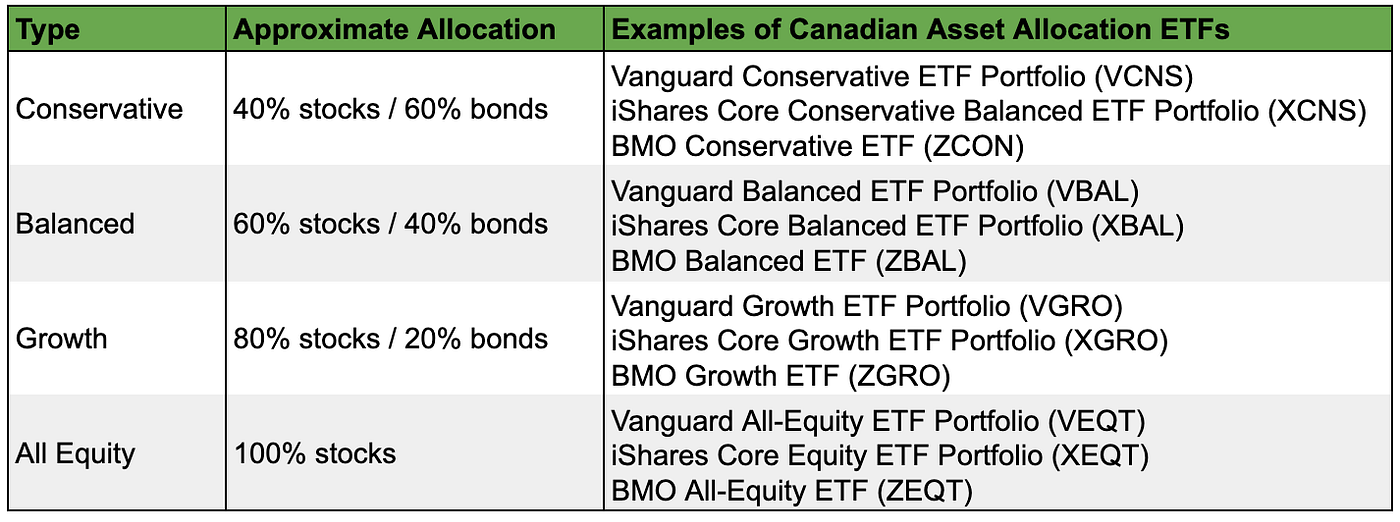
Note: These ETFs are examples of asset allocation funds available in Canada and are not recommendations to buy or sell any specific investment. Similar ETFs are also offered by other providers. Before investing, you should understand the fund’s holdings, fees, asset allocation, and whether it matches your investment goals and risk tolerance.
One of the biggest advantages of asset allocation ETFs is simplicity. Instead of buying separate stock and bond ETFs and deciding how much to allocate to each, investors can buy a single ETF that already maintains their desired mix of stocks and bonds. These ETFs usually automatically rebalance their holdings when market movements cause the allocation to move away from its target. This makes investing easier and helps investors stay disciplined with their long-term strategy.
8. Investing for Long-Term Goals — Can Accept More Risk
When your investment goal is many years away, you have more flexibility to accept short-term ups and downs in exchange for the possibility of higher long-term returns. For example, if you are investing for a retirement that is 30 or 40 years away, a temporary drop in the stock market is much less concerning.
Historically, stocks have provided higher long-term returns than safer investments such as savings accounts, GICs, and bonds. For this reason, many long-term investors allocate a larger portion of their portfolio to stocks or stock ETFs. Unlike short-term or medium-term investors, long-term investors usually do not need to worry about the daily, monthly or yearly fluctuations in their investment values. Instead, they should focus on staying invested and allowing time and compounding to work.
However, investors should be mindful that a portfolio invested mostly in stocks can decline significantly during market downturns. Broad stock markets have experienced declines of 20% and more during major market corrections. Historically, broad global stock markets have recovered from major market declines and have gone on to reach new highs over the long term. However, there is no guarantee that future market behaviour will be identical to the past.
The important question is not whether your investments will decline temporarily — it is whether you can stay invested and avoid making emotional decisions when those declines occur.
For a young investor with a long investment horizon, a portfolio with a higher allocation to stocks may be appropriate. As retirement approaches, or as the date when the money will be needed gets closer, many investors gradually shift a larger portion of their portfolio into fixed-income investments to reduce the impact of market fluctuations.
The key lesson: When your investment goal is decades away, short-term market drops are normal bumps in the road. Success comes from staying invested, continuing your regular contributions, and letting time and compounding do the heavy lifting.
See Also: Time in the Market vs. Timing the Market
Key Takeaway
Asset allocation is not about finding the best investment — it is about choosing the right mix of investments for your goals.
The amount of risk you should take depends largely on when you will need the money.
- Emergency fund: Safety and easy access are the priority.
- Short-term goals: Protect your money with cash or short-term fixed-income investments.
- Medium-term goals: Consider balancing growth and stability with a mix of stocks and fixed-income investments.
- Long-term goals: A higher allocation to stocks may be appropriate because you have more time to ride out market fluctuations.
There is no one-size-fits-all portfolio. The best asset allocation is the one that matches your goals, your time horizon, and your ability to stay invested during periods of market volatility.
What’s Next?
By now, you have learned about different types of investments and how to match them to your goals and time horizon through asset allocation. The next step is deciding where to hold those investments.
Canada offers several types of investment accounts, including the Tax-Free Savings Account (TFSA), Registered Retirement Savings Plan (RRSP), First Home Savings Account (FHSA), Registered Education Savings Plan (RESP), and non-registered accounts. Choosing the right account can help you reduce taxes and keep more of your investment returns.
Read Next: Part 6: Tax-Free Savings Account (TFSA)
Disclaimer: This article is for educational purposes only and is not financial or tax advice. Please consult a qualified tax or financial professional before making any decisions.
What are your thoughts on this post? Share your comments with us.
Stay ahead of the curve. Subscribe here to get notified whenever I publish a new guide or tool.
Share your comment or feedback. We'll get back to you as soon as we can.