A Beginner’s Guide to Investing (Part 4): Understanding Risk and Return
Learn what investment risk really means and how it affects your returns
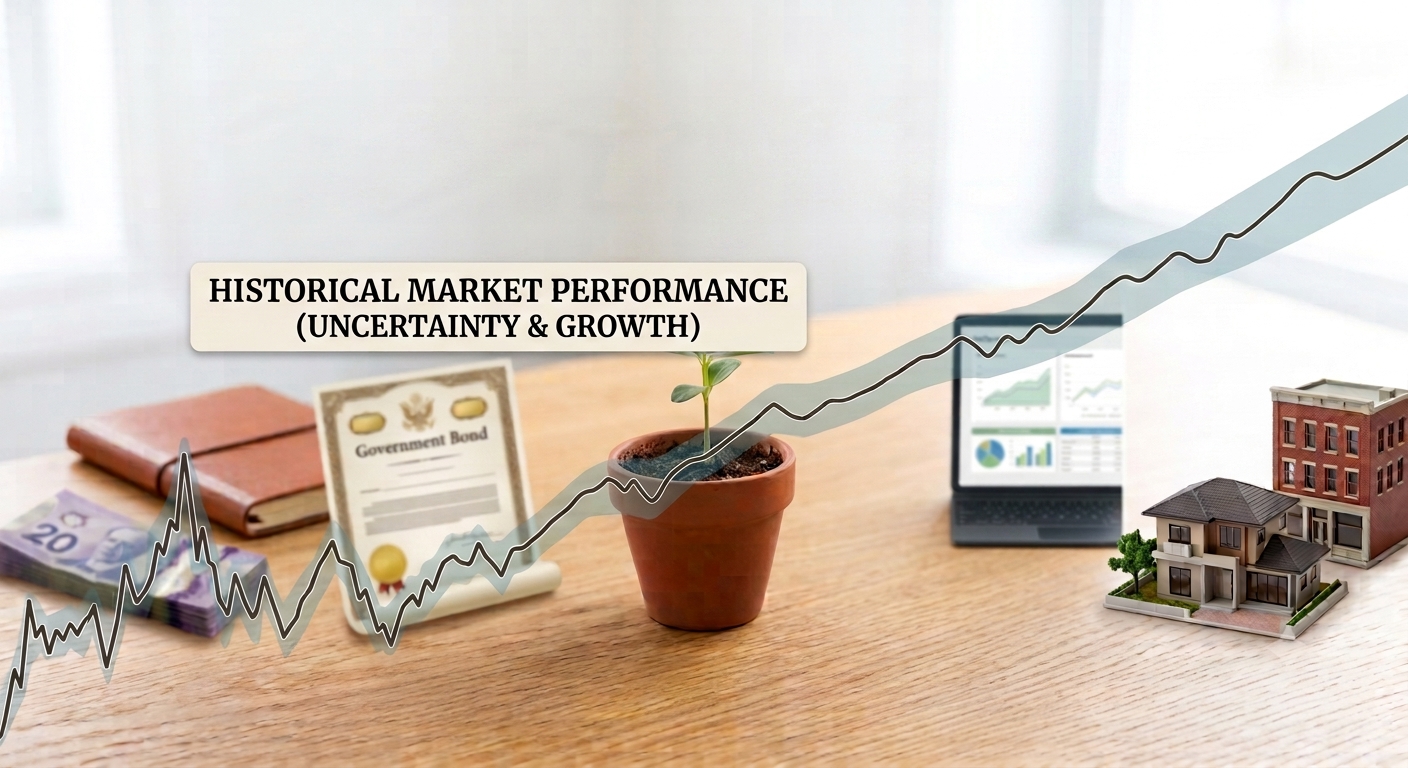
In Part 3, we looked at the different types of investments available to investors. In this article, we’ll explore one of the most important concepts in investing: risk and return.
When I moved to Canada in the late 1990s, I knew almost nothing about the Canadian or U.S. stock markets. One day, I told a colleague that I had some savings and wanted to invest in Canadian stocks.
He replied:
Investing in stocks is risky. You should avoid it.
At the time, I didn’t know what he meant by risky.
What is a Risky Investment?
The word risk is often used in financial circles without much explanation, which can be confusing for beginners. When my colleague asked me to avoid buying stocks, what did he mean? Did he mean I could lose all of my money? Did he mean the value of my investment could go up one year and down the next?
This is where many beginners get confused. In everyday language, risk often means the possibility of something bad happening. In investing, however, the word has a more specific meaning: uncertainty.
Most of the time, when financial advisors talk about risk, they are referring to uncertainty. You do not know exactly what return your investment will earn or how its value will change over time. Some years your investment may go up significantly, while in other years it may lose value. For example, instead of earning a steady, predictable return every year, your investment might gain 12% one year, lose 5% the next, and gain 15% the year after.
Many beginners mix this up and assume that risk automatically means:
- I am going to lose my investment completely.
- A risky investment guarantees great returns.
Neither is quite true.
Depending on what you invest in, there may also be a possibility of losing a significant portion of your original investment. Also, a risky investment may provide low returns, even lower than a GIC. However, for a well-diversified investment portfolio, temporary ups and downs are much more common than losing everything. Historically, over the long term, well-diversified stock markets have recovered from major downturns, though future performance can never be guaranteed.
Understanding that risk equals uncertainty is a vital lesson for investors, particularly beginners. Once you accept that volatility is normal, choosing investments that match your goals and risk tolerance becomes much easier.
Do all Investments Carry the Same Risk?
No. Different investments carry vastly different levels of risk.
Some investments like Savings Accounts, High-Interest Savings Accounts and Guaranteed Investment Certificates (GICs) are often viewed as almost risk-free, as these are offered by large financial institutions and are usually insured by a Government Institution up to a certain limit.
On the other hand, if you invest in bonds, stocks, mutual funds, ETFs, real estate, etc., you are on your own, as generally these are not insured, and their value can rise or fall in the short term or even long term, depending on market conditions and many other factors.
On the other hand, when you invest in bonds, stocks, mutual funds, or ETFs, your money is exposed to the market. Their values fluctuate based on dozens of unpredictable factors, including:
- A company performs better or worse than expected.
- A new company enters the market and takes away business from an existing company.
- A new technology disrupts an existing industry (for example, Artificial Intelligence).
- Interest rates or government policies change.
- Economic recessions.
- Natural disasters such as earthquakes, floods, or droughts.
- Product recalls or major lawsuits.
- Trade disputes, tariffs, or sanctions.
- Wars or geopolitical conflicts.
These are just a few of the many factors that can affect the value of your investments. Because events like these are difficult to predict, investing always involves some level of uncertainty (risk).
The important thing to remember is that higher risk does not mean an investment will perform poorly — it simply means the outcome is less predictable.
Why Do Riskier Investments Offer Higher Potential Returns?
One question many beginners ask is:
If stocks are riskier than savings accounts or GICs, why would anyone invest in them?
The answer is simple: investors expect to be rewarded for taking on additional risk.
If an investment is very safe and predictable, most investors are willing to accept a lower return. However, if an investment involves more uncertainty, investors usually expect the possibility of a higher return as compensation for taking that additional risk.
Think about lending money. If you deposit your savings in a major Canadian bank, the risk of not getting your money back is incredibly low, so banks offer a low interest rate, and you accept it.
But if a neighbour asks to borrow that same amount of money to start a business, the risk of not getting your money back is much higher. You would naturally expect to charge a higher interest rate to compensate for that risk.
This same principle applies to corporations and governments when they borrow money or issue shares. If investors believe a country’s financial situation is uncertain, that country may need to pay higher interest rates to borrow money. For example, during the European debt crisis from 2010 to 2012, investors worried about Greece’s ability to repay its debt. To attract buyers, the Greek government was forced to offer massive interest rates on its bonds.
This is also why stocks have historically provided higher long-term returns than savings accounts, GICs, or bonds. Unlike a savings account, there is no guarantee that a stock will increase in value from year to year. Investors accept these ups and downs because they expect higher average returns over the long term. Of course, higher potential returns do not mean guaranteed returns — riskier investments can, and do, lose money.
Risk Depends on Your Situation
There is no single investment that is right for everyone. The best choice for you depends on your unique goals, when you need the money, and how comfortable you are watching the value of your portfolio move.
Two key concepts to understand are:
- Time Horizon: How long you plan to keep your money invested before you need to withdraw it.
- Risk Tolerance: How comfortable you are emotionally with the daily ups and downs of your investments. For example, how will you react if you notice that your investment of $10,000 has dropped to $8,000 within a single year?
To see how these concepts work in the real world, let’s look at two different investors:
- Sarah is saving for a down payment on a home that she plans to buy in two years. Because she will need her money very soon, her time horizon is short. She should prefer low-risk investments like GICs or high-interest savings accounts that protect her principal.
- David is 30 years old and is investing for a retirement that is more than 30 years away. He has a long time horizon. He understands that his investments will rise and fall over the years, but he has plenty of time to recover from temporary market declines. Because of this, he can choose relatively riskier investments, like stocks or equity ETFs, in the hope of earning higher long-term returns.
Neither approach is right or wrong. The best investment depends on each person’s goals, time horizon, and comfort with risk.
What can you do to Reduce the Investment Risk?
Diversify: Don’t Put All Your Eggs in One Basket
The single most effective way to manage market uncertainty is diversification, which means spreading your money across many different investments.
If you invest all your savings into a single company and that business fails, your entire portfolio goes down with it. However, if your money is spread across hundreds of different companies, the downfall of one company will have a small impact on your overall wealth.
History has shown that even large and successful companies can fail. In the early 2000s, many Canadian investors believed companies such as Nortel Networks or Enron would continue to grow, but both eventually collapsed, causing significant losses for shareholders. At its peak, Nortel Networks made up over a third of the entire Toronto Stock Exchange (TSX). Investors who invest most of their money in a single company like Nortel suffer devastating, permanent losses when that company fails, while those with diversified portfolios are much less affected.
This is one reason diversified investment funds, such as Exchange-Traded Funds (ETFs) and mutual funds, are popular among many investors, especially beginners. These funds allow investors to own a small portion of many different companies and reduce their dependence on the success of any one company. ETFs can also help investors diversify beyond their own country by allowing them to invest in thousands of companies around the world. This means an investor can own a small piece of many companies across different countries and industries through a single investment.
By diversifying globally through a single fund, you protect yourself from the failure of any one company, industry, or single country’s economy.
Key Takeaway
Investing always involves some risk — there is no way to avoid it if you want your money to grow.
By understanding your timeline, identifying your comfort level with market swings, and using diversification to protect your savings from individual company failures, you can invest with confidence.
What’s Next?
Now that you understand how risk, return, and diversification work in theory, how do you actually put these pieces together in the real world? How do you choose the exact mix of GICs, bonds, and stocks that fits your specific life goals?
In “Part 5: Asset Allocation — How to Build a Portfolio,” we will look at how to design an investment portfolio tailored precisely to your personal timeline and risk tolerance.
Read Next: Part 5: Asset Allocation
Disclaimer: This article is for educational purposes only and is not financial or tax advice. Please consult a qualified tax or financial professional before making any decisions.
What are your thoughts on this post? Share your comments with us.
Stay ahead of the curve. Subscribe here to get notified whenever I publish a new guide or tool.
Share your comment or feedback. We'll get back to you as soon as we can.