A Beginner's Guide to Investing (Part 14): RRSP vs. TFSA - Which is Better?
How to Choose the Right Tax-Advantaged Account to Maximize Your Wealth and Minimize Your Taxes
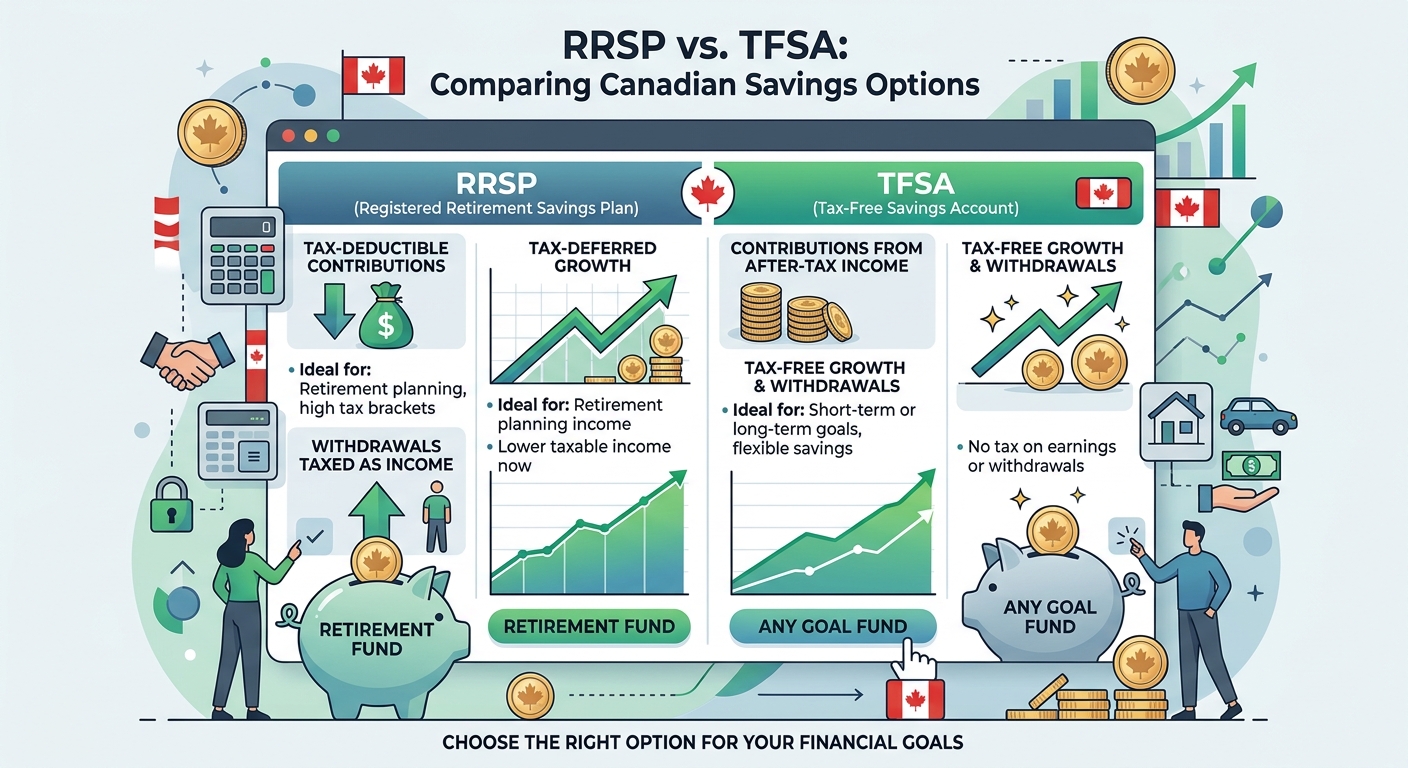
The Registered Retirement Savings Plan (RRSP), introduced in 1957, has long been an important retirement savings vehicle for Canadians. In 2009, the Canadian government introduced the Tax-Free Savings Account (TFSA), providing Canadians with another tax-advantaged way to save and invest.
Many investors consider the RRSP their primary retirement savings vehicle, while others believe the TFSA may be a better choice.
In Parts 6 and 7 of this series, we introduced the TFSA and RRSP, respectively. However, we discussed each account separately rather than comparing them directly. In this article, we compare the two accounts to help you decide which one best fits your financial situation.
Comparing Investing in the RRSP and the TFSA
When comparing an RRSP and a TFSA, it is important to look beyond their immediate tax advantages. Several factors can influence which account is more suitable for you.
We will explore the following factors:
- Tax advantages at the time of contribution
- Contribution room
- Tax treatment of investment growth
- Withdrawal flexibility
- Retirement income and government benefits
- Certainty and estate planning
- Employer RRSP matching
Finally, we will bring these factors together to consider which account may be more suitable for different financial circumstances.
Tax Advantages at the Time of Contribution
When you contribute money to an RRSP and claim the deduction on your tax return, your taxable income is reduced, which means you pay less income tax.
For example, suppose your employment income is $100,000, and you contribute $10,000 to your RRSP. Assuming you claim the full deduction, your taxable income would be reduced by $10,000, from $100,000 to $90,000.
If your employer has already deducted income tax from your salary, you may receive a tax refund when you file your tax return after claiming your RRSP deduction.
Let us assume that you have $10,000 in pre-tax income available to invest and that your marginal tax rate is 30%.
If you contribute the full $10,000 to an RRSP, you can invest the entire amount in the account. The contribution would generate approximately $3,000 in tax savings, assuming the full contribution is deductible and the applicable marginal tax rate is 30%.
If you choose a TFSA instead, you would first pay $3,000 in tax on that $10,000 of income, leaving $7,000 to invest in your TFSA.
Thus, an RRSP allows you to invest the full pre-tax amount, whereas a TFSA allows you to invest the amount remaining after tax. This gives the RRSP an immediate tax advantage. However, as we will see, the tax treatment of investment growth and withdrawals also matters when deciding which account is better for you.
Impact on Government Benefits
RRSP contributions may provide an additional benefit to low- and modest-income households. By reducing family net income, an RRSP deduction may increase the Canada Child Benefit (CCB) for families with eligible children and the Canada Groceries and Essentials Benefit (CGEB), formerly known as the GST/HST credit.
For the July 2026 to June 2027 benefit period, the CCB begins to decrease when adjusted family net income exceeds $38,237. The CGEB phases out as income rises, with eligibility thresholds of $60,012 for a single person without children and $64,232 for a couple without children. Higher thresholds apply to families with children
These benefits are income-tested, and the amounts received depend on family circumstances. For many middle- and higher-income households, they may be less significant than the RRSP’s direct tax advantages and the long-term effects of investment growth and withdrawals.
Contribution Room: RRSP vs. TFSA
RRSP and TFSA contribution room is calculated differently.
Your RRSP contribution room is based on your previous year’s earned income, subject to an annual maximum and other applicable rules. You accumulate new RRSP contribution room when you earn employment or other qualifying income. Once you retire and no longer have qualifying earned income, you stop accumulating new RRSP contribution room.
In contrast, TFSA contribution room is available regardless of whether you are employed or retired. Every eligible Canadian resident aged 18 or older receives the same annual TFSA contribution limit, regardless of employment income.
This makes the TFSA particularly useful in retirement, allowing retirees to continue to contribute and invest money in their TFSA.
Tax Treatment of Investment Growth Inside an RRSP and a TFSA
Both RRSPs and TFSAs offer tax-free investment growth while your money remains inside the account. Whether you earn interest, receive dividends, or realize capital gains, you generally do not pay Canadian income tax on these earnings inside either account.
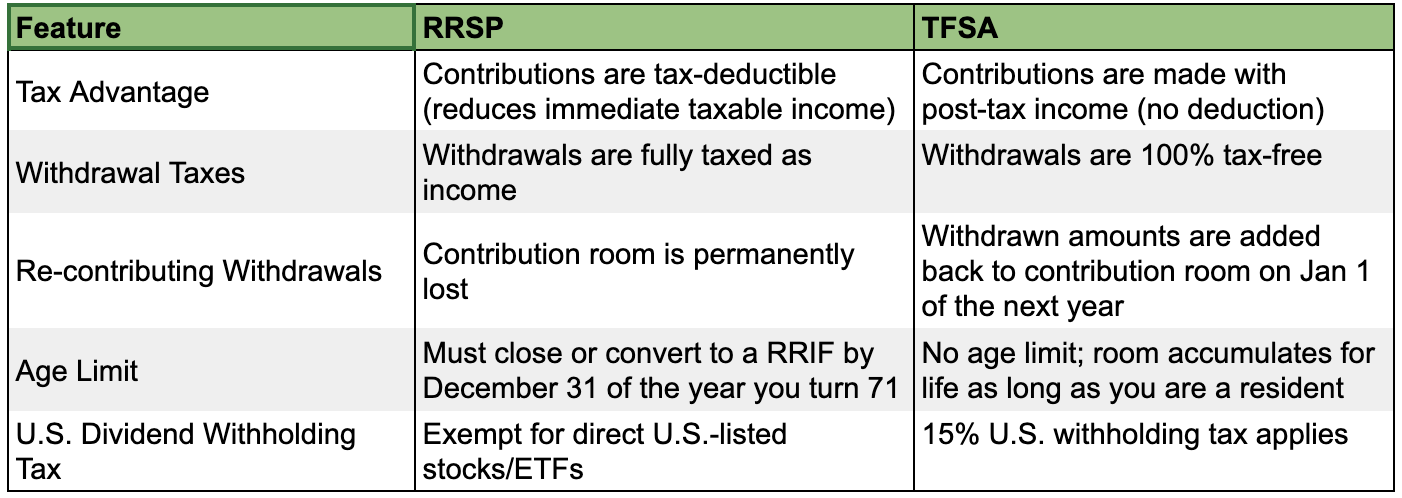
However, there is one notable difference when investing in U.S. dividend-paying stocks and ETFs. Dividends from eligible U.S.-listed stocks and ETFs held directly in an RRSP are generally exempt from the 15% U.S. withholding tax. In a TFSA, this tax generally applies to U.S. dividends and cannot be recovered.
For many small investors, this tax advantage may be relatively minor. Many Canadian investors prefer Canadian-listed ETFs that hold U.S. stocks rather than buying U.S.-listed stocks and ETFs directly. Buying U.S.-listed investments may involve currency conversion costs. As a result, the U.S. dividend withholding tax difference between an RRSP and a TFSA may have little impact on their overall returns.
Withdrawal Flexibility
TFSA withdrawal rules are very flexible — you can withdraw any amount from your TFSA at any time, without having to provide a reason, and all withdrawals are tax-free.
Furthermore, when you withdraw money from your TFSA, the amount withdrawn is added back to your contribution room on January 1 of the following year. For example, if you withdraw $10,000 from your TFSA today, that amount is added back to your contribution room on January 1 next year. You can then recontribute that amount.
On the other hand, RRSP withdrawals have several restrictions and tax implications:
- Withdrawals are taxable: RRSP withdrawals are fully included in your taxable income for the year, except for withdrawals under certain special programs, such as the Home Buyers’ Plan (HBP) and the Lifelong Learning Plan (LLP), which have their own repayment rules.
- Tax is withheld at source: Your financial institution generally withholds 10% to 30% of your RRSP withdrawal as tax, depending on the amount withdrawn and your province of residence. However, this is only tax withheld at source; your final tax liability may be higher or lower depending on your total taxable income and province of residence.
- Withdrawals may increase your tax burden: RRSP withdrawals are added to your taxable income and may push you into a higher tax bracket, especially if you are still working. They may also reduce income-tested benefits, such as the Canada Child Benefit (CCB) and the Canada Groceries and Essentials Benefit (CGEB), depending on your family income and circumstances.
- Contribution room is permanently lost: Unlike a TFSA, when you withdraw money from an RRSP, the amount withdrawn is not added back to your RRSP contribution room. (Note that the HBP and LLP have separate repayment rules.)
For more details on RRSP withdrawals, withholding taxes, the Home Buyers’ Plan (HBP) and the Lifelong Learning Plan (LLP), see RRSP Withdrawals and Taxes.
RRSP Retires at 71, but TFSA Lives Forever
Your RRSP has to retire by the end of the year you turn 71. In other words, you can no longer contribute to your own RRSP after December 31 of that year. In contrast, your TFSA lives forever — you do not need to close it as long as you are alive. You also continue to accumulate new TFSA contribution room every year, regardless of your age or employment status, and can use that room to invest more money if you wish.
When your RRSP reaches the end of its permitted period, you have a few options — withdraw the money, use it to purchase an eligible annuity, or convert it into a Registered Retirement Income Fund (RRIF). Many people choose a RRIF to keep their retirement savings invested, allowing their investments to continue growing tax-deferred.
A RRIF comes with its own set of rules:
- You cannot make new contributions to a RRIF.
- You must make minimum annual withdrawals starting in the year after you establish the RRIF. These minimum amounts are calculated using your RRIF’s value at the beginning of the year and your age, or your spouse’s age if you elect to use it when setting up the RRIF.
- The minimum percentage you must withdraw increases as you get older.
- All amounts withdrawn from a RRIF are included in your taxable income for that year.
For more details on the rules governing a Registered Retirement Income Fund, see Registered Retirement Income Fund (RRIF).
In contrast, you are not required to make any withdrawals from your TFSA. You can leave your money invested for as long as you wish, and any amount you withdraw is completely tax-free.
RRIF Withdrawals Impact on Government Benefits in Retirement
Besides paying tax on RRIF withdrawals, it can also affect two important government benefits:
- Guaranteed Income Supplement (GIS): The GIS provides additional financial support to low-income seniors who receive Old Age Security (OAS). GIS payments are income-tested, so RRIF withdrawals can reduce the amount you receive. For many GIS recipients, an additional dollar of income can reduce GIS by up to 50 cents. This means the combined effect of income tax and reduced GIS can make RRIF withdrawals particularly costly for low-income retirees.
- Old Age Security (OAS) recovery tax: Seniors with net income above a specified annual threshold must repay part of their OAS pension through the OAS recovery tax, commonly known as the OAS clawback. The recovery tax is 15% of income above the applicable threshold, up to the amount of OAS received. Because RRIF withdrawals are included in taxable income, larger withdrawals can trigger or increase the recovery tax.
Certainty and Simplicity in Retirement Planning
A TFSA can make retirement planning simpler and more predictable. You contribute money on which you have already paid tax, and all investment growth and withdrawals are tax-free. TFSA withdrawals do not increase your taxable income or directly trigger the OAS recovery tax or reduce income-tested benefits such as GIS. When you die, the remaining TFSA assets can pass to your heirs without Canadian income tax.
An RRSP, on the other hand, requires more planning. You do not know what tax rate will apply to your withdrawals during retirement, and mandatory RRIF withdrawals can increase your taxable income and potentially reduce income-tested benefits or trigger the OAS recovery tax.
Another important consideration is the tax payable when you die. If you leave a substantial RRSP or RRIF balance, the remaining amount is included in your final tax return, unless a tax-deferred transfer or another exception applies. This can result in a large tax bill, particularly if you die with a substantial balance and have no spouse or common-law partner who qualifies for a tax-deferred transfer.
Which Is Better: RRSP or TFSA?
The main tax difference between an RRSP and a TFSA is when you pay income tax.
With a TFSA, you contribute money on which you have already paid tax. Your investments grow tax-free, and withdrawals are also tax-free.
With an RRSP, you receive a tax deduction for your contributions, allowing you to defer tax until you withdraw the money. Your investments grow tax-deferred, but withdrawals are included in your taxable income. The same rules apply when you convert your RRSP into a Registered Retirement Income Fund (RRIF).
If we set aside the impact on government benefits, the choice largely depends on your tax rate when contributing compared with your tax rate when withdrawing the money. If your tax rate is lower during retirement than during your working years, an RRSP may offer a tax advantage. If your tax rate is higher during retirement, a TFSA may be more advantageous. If the two tax rates are the same, an RRSP and a TFSA can provide the same after-tax benefit.
Employer RRSP Matching
Another important factor is an employer’s RRSP matching program. If your employer matches your contributions, contributing enough to receive the full match is usually a good choice, subject to the plan’s rules and conditions. The employer’s contribution provides an immediate boost to your retirement savings.
Other Factors to Consider
The decision is not always straightforward. Several other factors can influence whether an RRSP or TFSA is more suitable for you, including:
- Your current income and marginal tax rate.
- Whether you expect your income and marginal tax rate to increase or decrease during the rest of your working life.
- Your expected income and tax rate during retirement.
- The age at which you retire and begin withdrawing your savings.
- Whether RRSP or RRIF withdrawals could reduce income-tested government benefits, such as the Guaranteed Income Supplement (GIS).
- Whether your income could trigger the Old Age Security (OAS) recovery tax.
- The potential tax payable on your remaining RRSP or RRIF balance when you die, depending on your circumstances and whether a tax-deferred transfer is available.
A TFSA offers greater certainty about the tax treatment of withdrawals and can simplify retirement and estate planning. An RRSP, however, can provide a significant tax advantage when contributions are made at a higher tax rate than the rate that applies to withdrawals during retirement.
Neither account is always the better choice. The right option depends on your income, retirement plans, eligibility for government benefits and overall financial circumstances.
In future articles, we will explore these factors in more detail and examine RRSP and TFSA strategies for low-, middle- and high-income Canadians.
Check out other articles in this series: A Beginner’s Guide to Investing
Disclaimer: This article is for educational purposes only and is not financial or tax advice. Please consult a qualified tax or financial professional before making any decisions.
What are your thoughts on this post? Share your comments with us.
Stay ahead of the curve. Subscribe here to get notified whenever I publish a new guide or tool.
Share your comment or feedback. We'll get back to you as soon as we can.