A Beginner's Guide to Investing (Part 10): Registered Retirement Income Fund (RRIF)
Rules, mandatory minimums, and tax-smart strategies for your RRIF.

In Part 9, I mentioned that you need to wind up your RRSP by the end of the year you turn 71. The same rule applies to a Spousal RRSP: the annuitant (owner) must wind up the Spousal RRSP by December 31 of the year they turn 71. However, most people convert their RRSP to a Registered Retirement Income Fund (RRIF) before this deadline.
Note: Your RRSP must be dealt with by December 31 of the year you turn 71. After that date, you no longer have an RRSP. However, you can still contribute to an open Spousal RRSP.
Understanding a Registered Retirement Income Fund
Think of a Registered Retirement Income Fund (RRIF) as the second phase of your financial journey. During the first phase, you invested money in your RRSP to save for retirement. In the second phase, you use a RRIF to generate retirement income.
To some extent, a RRIF is similar to an RRSP because your investments in a RRIF continue to grow tax-deferred. However, there are two major differences:
- You can’t deposit new money in your RRIF, even if you have RRSP contribution room.
- You must withdraw a mandatory minimum amount from your RRIF every year. The amount withdrawn is treated as income for that year, and you pay tax on it.
While you can technically open a RRIF at any age, many people choose to do so when they retire or sometime before age 71
Converting an RRSP to an RRIF
Converting your RRSP to a RRIF is usually a straightforward process — you open a RRIF account and ask your financial institution to transfer your investments from the RRSP to the RRIF “in-kind.”
Note: “In-kind” means that your holdings (stocks, ETFs, GICs, etc.) get transferred directly from your RRSP to your RRIF without having to sell and rebuy them.
Most financial institutions can complete the transfer within a few business days, although fees and processing times may vary.
The Mandatory Minimum Withdrawal
When you contributed money to your RRSP, you received a tax deduction, and your investments were allowed to grow tax-deferred. When you transfer your RRSP investments to a RRIF, you don’t pay any tax on the transfer, and your investments continue to grow tax-deferred in the RRIF.
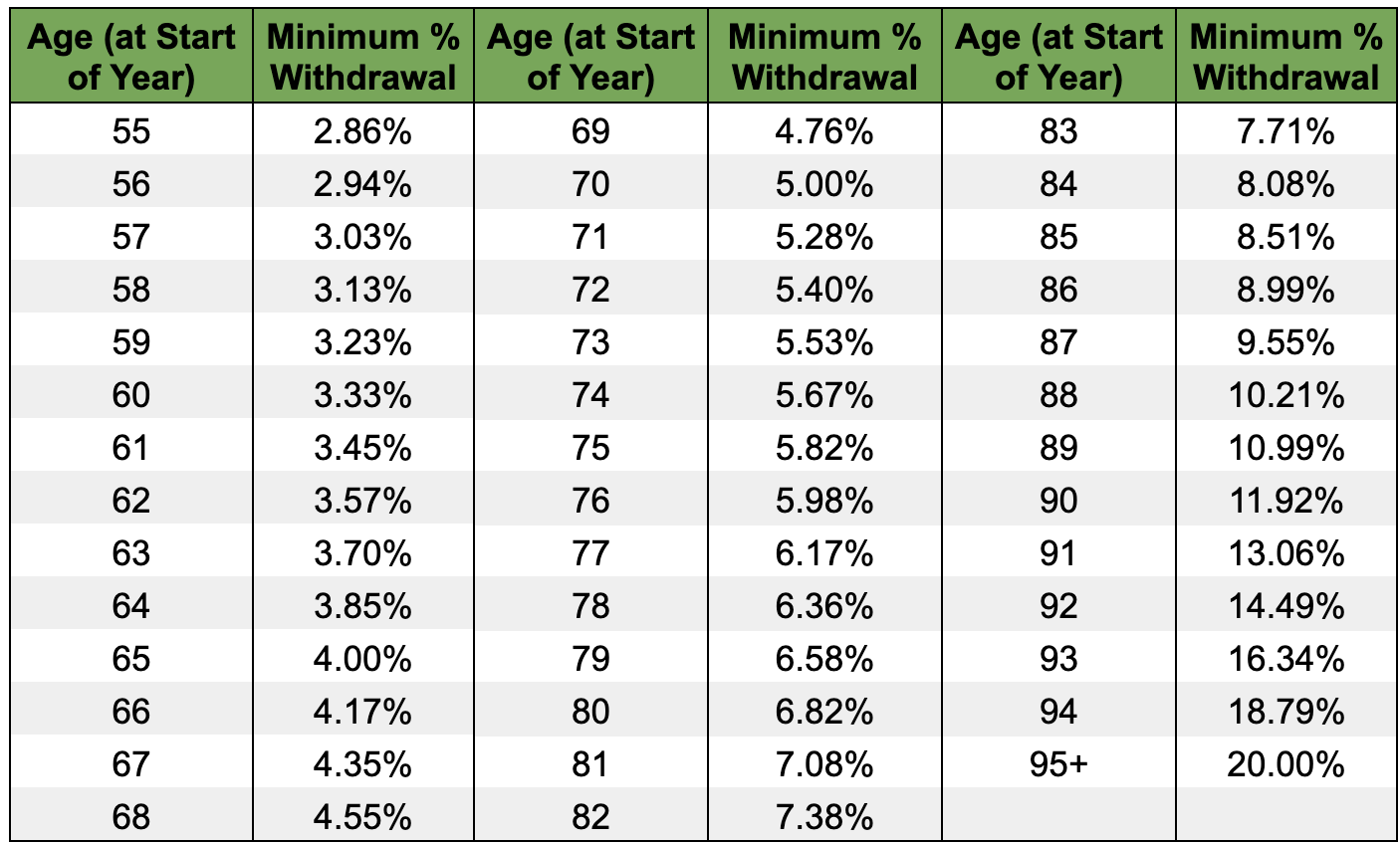
To ensure that the money in your RRIF doesn’t remain tax-deferred indefinitely, the government requires you to withdraw a minimum amount each year.
The minimum RRIF withdrawal for each year is based on:
- The value of your RRIF on January 1 of that year.
- Your age on January 1 of that year, or your spouse’s age if you elected to use your spouse’s age when you established the RRIF.
Note: You are not required to make a withdrawal in the calendar year you open a RRIF. Your first mandatory withdrawal starts the following year.
Note: The mandatory withdrawal is only the minimum amount you must take out. You can withdraw more than the minimum amount at any time. However, withdrawals above the minimum are subject to withholding tax. (See next section about withholding tax.)
The minimum withdrawal percentage is based on your age at the start of the year and generally increases as you get older. The following table shows the minimum RRIF withdrawal rates as of 2026.
RRIF Withdrawals May Affect Other Benefits
100% of withdrawals from an RRIF are considered income for that tax year, and they can push taxable income higher — potentially reducing or eliminating eligibility for income-tested benefits such as the Guaranteed Income Supplement (GIS) and triggering Old Age Security (OAS) clawbacks. Once mandatory withdrawals begin, you generally have to withdraw at least the minimum amount each year.
The Spousal Age Election
When you first set up your RRIF, you can choose to base your minimum withdrawals on your spouse’s age instead of your own. If your spouse is younger, this results in a lower mandatory withdrawal, allowing more of your money to remain in the tax-sheltered RRIF for a longer period.
Important: This election must be made when you establish the RRIF. Once you make the election, you generally cannot change it.
How RRIF Withdrawals Are Taxed
It is important to remember that every dollar you withdraw from a RRIF is taxable income. In other words, you must report all RRIF withdrawals on your tax return and pay tax accordingly. Besides, when you withdraw money from your RRIF, withholding tax may be applicable.
No Withholding Tax on the Minimum Amount
Your financial institution is not legally required by the CRA to withhold tax on the mandatory minimum RRIF withdrawal amount. However, if you prefer, you can voluntarily ask your financial institution to withhold some tax from each RRIF withdrawal payment. This can help you to avoid a situation at tax time when you discover that you owe a large tax bill to the CRA and you don’t have ready cash available to pay that bill.
Withholding Tax is Applicable Above the Minimum Amount
For any withdrawal above the mandatory minimum amount, your financial institution is legally required to withhold tax.
For example, suppose the minimum is $20,000, and you withdraw $30,000.
The institution doesn’t apply the withholding rate to the entire $30,000. The mandatory minimum portion is treated differently, and withholding tax on the additional $10,000 applies according to the prescribed rates.
Like RRSP withdrawals, the withholding tax depends on the withdrawal amount above the mandatory minimum amount, as shown:

For a $10,000 withdrawal above the mandatory minimum amount, the withholding tax is $2,000 (20% of $10,000) in all provinces and territories, except in Quebec, where it is $2,400 (24%, i.e., 10% Federal plus 14% Quebec). Your financial institution deducts the withholding tax from the total withdrawal amount, remits it to the government, and transfers the balance to your account.
Why Consider Converting Your RRSP Early
While you are only forced to wind up your RRSP at age 71, many Canadians find it beneficial to start this process earlier. Converting even a portion of your RRSP to a RRIF in your 60s can be a good tax move for two main reasons.
The Pension Income Credit
Starting at age 65, the first $2,000 of eligible RRIF withdrawals each year qualifies for the Federal Pension Income Amount. This non-refundable tax credit can significantly reduce the federal tax on that income. You may also qualify for a provincial or territorial pension income tax credit.
For example, a $2,000 RRIF withdrawal for a 65+ Ontario resident may reduce the tax bill by $388.98. (Tax credit varies by province/territory.)
The strategy: Depending on your other income, even if you don’t need the cash yet, once you’re 65 or older, it may make sense to convert a small portion of your RRSP to a RRIF, withdraw $2,000 and claim this credit.
No Withholding Tax on Minimums
When you withdraw money from an RRSP, your financial institution generally has to withhold tax at source. RRIF minimum withdrawals are treated differently because withholding tax is not required on the minimum amount. The benefit is that you get 100% of your RRIF money upfront. Though you still owe tax at the end of the year, you can use the money in the meantime, allowing it to stay invested or sit in a high-interest account for a few extra months.
The “RRSP Meltdown” Strategy
The “Meltdown” strategy is about smoothing out your taxes. If you wait until age 71 and have a very large RRSP, the mandatory minimums might push you into a much higher tax bracket, potentially triggering “clawbacks” on your Old Age Security (OAS).
By converting early, you can start chipping away at that large balance sooner. This “melts down” the total amount in your account so that when you hit 71, your mandatory payments are smaller and more manageable.
Note: We will discuss the RRSP Meltdown strategy in a future article. I will put a link to that article when published.
Pension Income Splitting
A powerful advantage for senior couples is the ability to “split” income for tax purposes. This helps them reduce the combined family tax, as each spouse pays tax on their individual income.
RRIF withdrawals are also eligible for splitting income—you can notionally allocate up to 50% of your RRIF income to your spouse. On the other hand, RRSP withdrawals are not eligible for income splitting. Therefore, to take advantage of pension income splitting, you need to convert your RRSP to an RRIF.
Note: The RRIF holder must be 65 or older on December 31 of that tax year to split RRIF income. The spouse receiving the split portion does not need to be 65. You make the election by jointly filing Form T1032, Joint Election to Split Pension Income, with your tax returns.
By shifting income from a high-tax-bracket spouse to a lower-bracket spouse, you can significantly reduce your household's total tax.
What Happens at the End
No one likes to think about it, but a key part of the RRIF strategy is deciding what happens to the money when you pass away. If you don’t plan for what happens to your RRIF when you die, the value of the RRIF can be included in your income on your final tax return, potentially creating a large tax bill for your estate, particularly if your RRIF is substantial.
For those with a spouse or common-law partner, there are two main ways to deal with a RRIF on death.
Naming a Successor Annuitant
If you name your spouse as the Successor Annuitant, the RRIF contract generally continues uninterrupted, and your spouse becomes the new annuitant (owner) of the account.
Because the RRIF continues in your spouse’s name, the usual tax that would otherwise arise from the RRIF’s value at your death is generally deferred. Your spouse becomes responsible for the RRIF’s mandatory withdrawals going forward.
This can be a simple and effective way to avoid an immediate tax liability when the first spouse dies.
Note: Only a spouse or common-law partner can be named a Successor Annuitant. Children or other heirs can only be named as Beneficiaries.
Naming a Beneficiary
You could name your spouse as the beneficiary instead. In that case, the RRIF does not simply continue as it would with a successor annuitant. However, if the conditions are met, the RRIF proceeds can generally be transferred to your spouse’s RRSP, RRIF or an eligible annuity on a tax-deferred basis.
Note: If you don’t have a spouse, you could name your children or a charity as beneficiaries. In that case, unless the beneficiary is a financially dependent child, the full value of the RRIF will likely be taxed as income on your final tax return.
What’s Next?
We have explored the fundamentals of RRSPs, RRSP withdrawals & taxes, Spousal RRSPs and converting an RRSP to a RRIF. In the next articles, we will cover additional topics on RRSPs, such as RRSP Meltdown and RRSP vs TFSA. I will add links to those articles when published.
Read Next: Part 11: RRSP Meltdown (coming soon)
Disclaimer: This article is for educational purposes only and is not financial or tax advice. Please consult a qualified tax or financial professional before making any decisions.
What are your thoughts on this post? Share your comments with us.
Stay ahead of the curve. Subscribe here to get notified whenever I publish a new guide or tool.
Share your comment or feedback. We'll get back to you as soon as we can.