A Beginner's Guide to Investing (Part 8): RRSP Withdrawals and Taxes
What Happens When You Take Money Out of Your RRSP
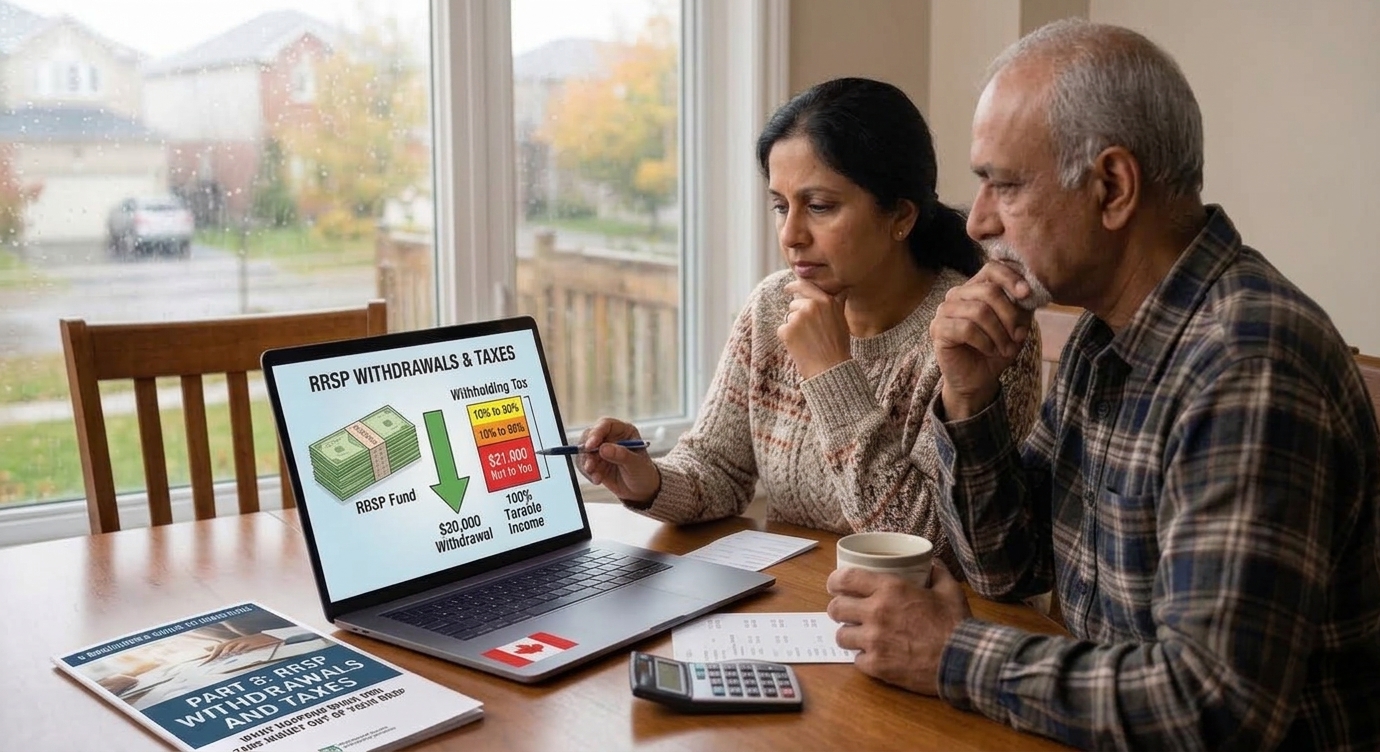
Now that we’ve established how to set up and fund your RRSP in Part 7, it’s time to look at the other side of the equation. In this article, we’ll explore what happens when you take money out of your RRSP, including withholding tax rates and tax implications.
You often get a lot of advice in favour of using an RRSP because it saves taxes up front; however, what many Canadians misunderstand is “what happens when you withdraw money from an RRSP?”
Almost all RRSP withdrawals are treated as 100% taxable income in the year they are withdrawn.
Note: There are two important exceptions to this rule, which we will discuss later.
Though the name RRSP (Registered Retirement Savings Plan) suggests that money will be withdrawn from an RRSP during retirement, the government does not impose any restriction on withdrawals from an RRSP. In other words, you can withdraw money from your RRSP at any time; however, these withdrawals have tax consequences.
What Happens When You Withdraw From an RRSP?
Let us assume that you ask your financial institution that holds your RRSP that you want to withdraw $30,000 from it and deposit it into your chequing account.
- First, you need to ensure that $30,000 is available in cash form in your RRSP account. If not, you will need to sell some assets (stocks, ETFs, Mutual funds, bonds, etc.) to have $30,000 in liquid cash in your RRSP account.
- Your financial institution is required to withhold tax on RRSP withdrawals — the withholding tax rates range from 10% to 30% (5% to 15% in Quebec, plus Quebec provincial withholding tax), as shown:

For a $30,000 withdrawal, the withholding tax is $9,000 (30% of $30,000) in all provinces and territories, except in Quebec, where it is $8,700 (29%, i.e., 15% Federal plus 14% Quebec). Your financial institution deducts the withholding tax from the total withdrawal amount, remits it to the government, and transfers the balance to your account. So, if you live in Ontario, you will get $21,000 in your chequing account, though the entire $30,000 will be added to your income for that year.
Withholding Tax Is Not Your Final Tax
The withholding tax is not a penalty on RRSP withdrawals — it is simply an approximate tax the government precollects, just like the taxes that are deducted from the regular periodic payments you receive from your employer. The RRSP withholding taxes will be adjusted against your final tax bill when you file your income tax return. Assume that your taxable income is $90,000 and you withdraw $30,000 from your RRSP; your total taxable income for that year will become $120,000, and you will be taxed accordingly.
Can you split withdrawals to pay less upfront tax?
Some people may be tempted to make multiple smaller withdrawals to pay less upfront tax. If you make separate withdrawal requests throughout the year (e.g., $10,000 in January, $10,000 in May, and $10,000 in September), your financial institution will generally treat them as individual requests and withhold 20% on each ($2,000 each).
Note: Asking for a single $30,000 withdrawal paid in instalments will trigger the full 30% rate on the entire amount.
Why this doesn’t Save You Money
Even if less tax is withheld upfront, your final tax bill doesn’t change. When you file your tax return, all $30,000 is added to your income. Because 20% withholding tax ($6,000 total) may not be enough to cover the actual tax owed on $30,000 of RRSP withdrawal income, you will owe a large balance to the CRA at tax time. In fact, paying less in withholding taxes may become an issue at tax time if you don’t have ready cash available to pay the balance tax.
RRSP Withdrawals Permanently Reduce Your Savings Room
When you withdraw money from your RRSP account, it results in a permanent loss of contribution room. Unlike a TFSA, you cannot simply put the money back into your RRSP in a future year and regain the contribution room you lost. Therefore, if you contributed to your RRSP for tax-deferred growth in the first place, the money you withdraw also loses the opportunity to continue growing tax-deferred inside the RRSP.
RRSP Withdrawals Can Push You into Higher Tax Brackets
If you withdraw money from your RRSP while still working a regular job, the RRSP withdrawal may push you into a higher tax bracket. This may happen because Canada follows a progressive tax bracket system, where higher income attracts higher tax rates. For example, consider the Ontario combined federal and provincial tax rates for 2026:
- income between $58,524 and $94,907: 29.65%
- income between $94,908 and $107,785: 31.48%
- income between $107,786 and $111,814: 33.89%
- income between $111,815 and $117,045: 37.91%
- income between $117,046 and $150,000: 43.41%
Note: These are marginal tax rates, meaning each rate applies only to the portion of income within that bracket. Your entire income is not taxed at the highest rate you reach.
Assume your taxable income is $90,000 and you have no other income; your highest marginal tax rate is then 29.65%. In other words, your last dollar will be taxed at 29.65%. Now, if you withdraw $30,000 from your RRSP, your taxable income is approximately $120,000. Some of the withdrawal will therefore fall into higher tax brackets. The average tax rate on the withdrawal will be higher than 29.65%.
This illustrates why the tax rate when you contribute to an RRSP and the tax rate when you withdraw from it can be very important. Ideally, you want to receive the RRSP deduction when your tax rate is relatively high and make withdrawals when your tax rate is lower.
RRSP Withdrawals May Reduce Income-Tested Benefits
Certain benefits like the GST/HST credit, Canada Child Benefit (CCB), Old Age Security (OAS), and Guaranteed Income Supplement (GIS) are income-tested. As RRSP withdrawals increase your income, they can reduce or even eliminate some income-tested benefits.
This is particularly important in retirement because RRSP or RRIF withdrawals can affect benefits such as OAS and GIS.
Special RRSP Withdrawal Programs
Two government programs, the Home Buyers’ Plan (HBP) and the Lifelong Learning Plan (LLP), allow you to take money from an RRSP without withholding tax.
Home Buyers’ Plan (HBP)
The Home Buyers' Plan (HBP) allows first-time home buyers to withdraw funds from their RRSP to buy or build a qualifying home. The current withdrawal limit, as of 2026, is $60,000, and no tax is withheld on these withdrawals. If you are a couple, each of you can withdraw up to $60,000 from your RRSP, i.e. up to $120,000 combined.
Think of an HBP withdrawal as borrowing from your own retirement savings. You are expected to repay the amount to your RRSP generally over 15 years. The payments start the second year after the year you make the withdrawal. The CRA Notice of Assessment provides details about the repayment you need to make under HBP.
Lifelong Learning Plan (LLP)
The Lifelong Learning Plan allows you to withdraw money from your RRSP without a withholding tax to finance full-time education or training for yourself, your spouse or common-law partner. The current annual withdrawal limit is $10,000 with a maximum lifetime total limit of $20,000. Like HBP, the withdrawal amount needs to be paid back to your RRSP over time.
When Might an RRSP Withdrawal Make Sense?
Whether one should withdraw money from their RRSP account is a personal decision and also depends on the purpose of withdrawal. If you are withdrawing money to buy your first home under HBP or to acquire new skills under LLP, it may be okay.
Another situation where withdrawal from an RRSP makes sense is if you lose your job and need money for your regular expenses. In this case, though RRSP withdrawals are taxable, you will not pay a lot of tax as your income during that year will be low. However, remember that you will not be able to recontribute the money back to your RRSP, and the withdrawn money loses the status of tax-deferred growth.
Withdrawals from an RRSP make the most sense when you are close to retirement or have retired, and you don’t have a lot of other income. For some people, the years between retirement and age 71 can provide a good opportunity to make RRSP withdrawals at relatively low tax rates, especially if they have little other income. This strategy is sometimes called an RRSP meltdown, and we will explore it in a future article
What Happens Next?
The government created the RRSP to encourage Canadians to save for retirement. While there is no official age of retirement in Canada, the RRSP has one — your RRSP has to retire by the end of the year you turn 71.
Read Next: Part 9: RRSP Contributions and Spousal RRSPs
Disclaimer: This article is for educational purposes only and is not financial or tax advice. Please consult a qualified tax or financial professional before making any decisions.
What are your thoughts on this post? Share your comments with us.
Stay ahead of the curve. Subscribe here to get notified whenever I publish a new guide or tool.
Share your comment or feedback. We'll get back to you as soon as we can.