A Beginner's Guide to Investing (Part 15): RRSP vs. TFSA for Low-Income Canadians
Why a TFSA may be a better choice for low-income Canadians, and how RRSP withdrawals can affect retirement income and GIS benefits.
In Part 14, we compared the key features of RRSPs and TFSAs and concluded that choosing between the two depends on several factors. In this article, we will explore which account may be more suitable for low-income Canadians.
What Is the Low-Income Range?
Canada has no single official definition or income threshold for “low-income.” Federal and provincial governments use different income thresholds to determine eligibility for income-tested benefits, such as the GST/HST credit, the Canada Child Benefit, the Canada Dental Care Plan and the Guaranteed Income Supplement (GIS). Eligibility may also depend on family size and household income.
Individuals earning close to the applicable provincial minimum wage would generally fall within the low-income range.
As of 2026, the lowest federal income tax bracket extends to $58,523. However, using this threshold to define low-income earners may not be appropriate, as many financial commentators consider the middle-income range to begin at around $50,000 to $55,000.
For the purpose of this article, I will consider individuals earning a gross annual income of up to $50,000 to be in the low-income range. With this definition in mind, let us explore whether low-income Canadians are better off investing in an RRSP or a TFSA.
Story of Two Savers
Assume that Bob and Raj, aged 25, are residents of Ontario, each earning an annual employment income of $50,000.
Based on 2026 tax rates, an individual earning $50,000 in Ontario would pay approximately $6,250 in income tax and contribute $3,582 towards CPP and EI premiums. This leaves an after-tax income of approximately $40,168.
Bob, the RRSP Saver
Bob decides to contribute $5,000 to his RRSP. Since RRSP contributions are tax-deductible, this reduces his taxable income and results in estimated tax savings of approximately $1,352.
Note: Employers generally deduct income tax at source based on the employee’s regular payroll information. Unless the employer adjusts tax deductions to account for Bob’s RRSP contribution, Bob would receive the resulting tax refund when he files his 2026 income tax return.
The following table summarizes the tax comparison:
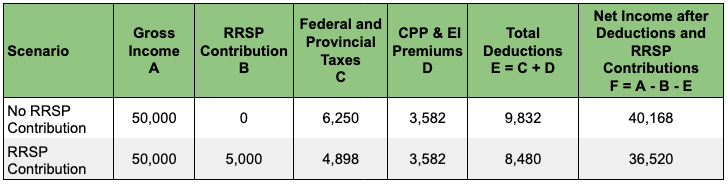
Notice that Bob’s RRSP contribution of $5,000 reduces his estimated income tax from $6,250 to $4,898, resulting in tax savings of approximately $1,352.
This represents a reduction in tax of approximately 27% of his RRSP contribution ($1,352 ÷ $5,000 × 100).
In other words, although Bob contributes $5,000 to his RRSP, his net cost is only $3,648 after accounting for the estimated tax savings ($5,000 − $1,352).
Raj, the TFSA Saver
Now, let’s consider Raj, who earns the same annual income as Bob but chooses to invest in a TFSA instead.
To make the comparison fair, assume Raj contributes $3,648 to his TFSA using after-tax income. Unlike Bob, Raj does not receive any tax deduction or refund for his contribution.
Thus, both Bob and Raj invest the same amount of their disposable income ($3,648), but Bob invests $5,000 in his RRSP while Raj invests $3,648 in his TFSA.
The Accumulation Phase: Investing for 40 Years
Now, let us assume that Bob and Raj continue investing for the next 40 years, until they reach age 65 and retire. Bob continues contributing $5,000 annually to his RRSP, while Raj contributes $3,648 annually to his TFSA. Both increase their annual contributions in line with inflation, keeping their contributions equivalent to these amounts in today’s dollars.
We will also assume that both invest in diversified equity portfolios and earn an average annual real rate of return of 5% (i.e., after adjusting for inflation).
Note: A 5% real return is a reasonable assumption for this illustrative example, considering the historical long-term returns of broad equity markets. Actual investment returns, of course, will vary from year to year and may be higher or lower.
Based on these assumptions, the accumulated investment values after 40 years, expressed in today’s dollars, would be approximately:
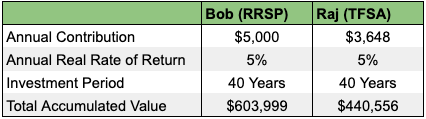
As you can see, Bob accumulates approximately $604,000 in his RRSP, compared with Raj’s $440,566 in his TFSA.
However, these figures do not tell the whole story. Bob’s RRSP withdrawals will be taxable, whereas Raj can withdraw his TFSA savings tax-free.
Therefore, to determine who is better off, we need to compare their investments after accounting for the taxes payable on withdrawals during retirement and the potential impact of those withdrawals on other income-tested benefits.
The Retirement Journey
Bob and Raj have retired at age 65.
During their working years, Bob and Raj each had $36,520 remaining after accounting for income tax, CPP/EI contributions and their respective annual savings contributions. Assume that they need $3,000 per month ($36,000 annually) in after-tax income during retirement.
For this example, assume that Bob and Raj are each entitled to a CPP retirement pension of approximately $875 per month ($10,500 annually), expressed in today’s purchasing power.
Since they have both lived in Canada for at least 40 years after turning 18, they would qualify for the full Old Age Security (OAS) pension, which is $762.50 per month ($9,150 annually) as of November 2026.
Their annual income from government benefits would therefore be:
- CPP: $10,500
- OAS: $9,150
- Total: $19,650
Since their required annual retirement income is $36,000, their government benefits leave a shortfall of $16,350, before accounting for income tax.
Bob and Raj have sufficient savings in their RRSP and TFSA, respectively, to cover this shortfall.
Bob’s RRSP Withdrawals
All withdrawals from an RRSP are 100% taxable. Therefore, Bob needs to withdraw an amount greater than the $16,350 shortfall to cover the applicable income taxes.
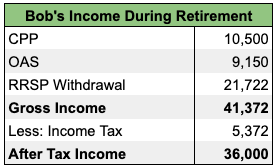
Based on 2026 Ontario tax rates, Bob needs to withdraw approximately $21,722 from his RRSP, bringing his total gross income to $41,372. This income will attract approximately $5,372 in income tax, leaving him with $36,000 in after-tax income.
With an assumed annual real return of 5%, Bob’s RRSP balance of approximately $604,000 would increase in value by about $30,200 during the first year, before withdrawals. Therefore, an annual withdrawal of approximately $21,722 would allow the account balance to continue growing under these assumptions. (Of course, actual investment returns will fluctuate.)
Here are Bob’s income sources to generate $36,000 in annual income:
Note: Bob could potentially reduce his income tax by converting a portion of his RRSP into a Registered Retirement Income Fund (RRIF) and withdrawing $2,000 annually from the RRIF. Since Bob is over 65, eligible RRIF withdrawals qualify for the pension income tax credit, whereas ordinary RRSP withdrawals do not. This credit would reduce his tax payable and, consequently, the total amount he needs to withdraw from his RRSP.
Raj’s TFSA Withdrawals
Unlike RRSP withdrawals, all TFSA withdrawals are 100% tax-free. However, before withdrawing money from his TFSA, Raj has another potential income source: the Guaranteed Income Supplement (GIS).
GIS is a monthly, non-taxable payment for eligible seniors with low incomes who receive Old Age Security (OAS). As of November 2026, a single, divorced or widowed senior with annual income below $23,112, excluding OAS, may qualify for GIS.
Note: Different income thresholds apply to couples, depending on their age and circumstances. In this example, we have assumed that Raj is a single senior.
Since Raj’s annual income excluding OAS is only $10,500, he is eligible for GIS. According to the Table of Benefit Amounts published by Employment and Social Development Canada for October to December 2026, the monthly GIS payment for an annual income of $10,500 is $525.90, or $6,310.80 annually.
Note: Bob’s annual income from CPP and RRSP withdrawals exceeds the GIS income threshold for single seniors ($23,112 in 2026). Therefore, he is not eligible to receive GIS.
With this additional $6,310.80 in GIS payments, Raj needs to withdraw much less from his TFSA to reach his target annual after-tax income of $36,000.
Here are Raj’s income sources to generate $36,000 in annual income:
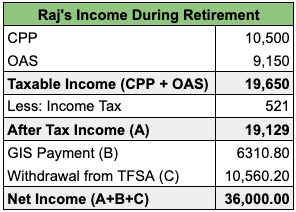
Raj’s TFSA account balance of approximately $440,566 at age 65, earning an assumed 5% real return, would generate about $22,028 in annual growth before withdrawals. Therefore, an annual withdrawal of approximately $10,560 would allow his TFSA balance to continue growing under these assumptions. Of course, actual investment returns will fluctuate.
Note: GIS is generally calculated using the previous year’s income. If Raj’s income falls substantially after retirement, he can ask Service Canada to use an estimate of his lower current-year income when determining his GIS entitlement.
TFSA Flexibility vs. RRIF’s Strict Withdrawal Rules
A TFSA offers complete flexibility: Raj can increase, decrease or stop withdrawals whenever he needs to. An RRSP, however, must be converted or otherwise dealt with by the end of the year Bob turns 71.
Most people transfer their RRSP savings into a Registered Retirement Income Fund (RRIF). Although investments can continue growing tax-free inside a RRIF, there is one important difference — a RRIF requires a minimum amount to be withdrawn every year.
The minimum withdrawal is not based on what Bob needs — it is calculated using a government-prescribed percentage of the RRIF’s value on January 1 of each year, based on his age. The percentage increases as he gets older. For example, the minimum withdrawal factor is 5.28% at age 71, 5.40% at age 72, 6.82% at age 80, 8.51% at age 85, 11.92% at age 90 and 20% at age 95 or older.
Let’s assume Bob’s RRSP balance grows to approximately $658,000 by the end of the year he turns 71, after accounting for his monthly withdrawals and the assumed 5% real annual return. He must transfer his RRSP to a RRIF or otherwise wind it up by December 31 of that year.
If Bob establishes his RRIF at age 71, his first mandatory minimum withdrawal will be in the following calendar year. Since Bob will still be 71 on January 1 of that year, the applicable minimum withdrawal factor will be 5.28%. Assuming the RRIF is worth $658,000 on January 1, his minimum withdrawal would be approximately $34,742. This entire withdrawal is taxable as income.
This is a significant increase from the approximately $21,722 Bob was withdrawing annually from his RRSP to meet his retirement income needs. Under the RRIF minimum withdrawal rules, he must now withdraw approximately $34,742, even if he does not need the additional money. The higher withdrawal will increase his taxable income and result in a higher income tax bill. It may also reduce his federal age amount tax credit, which is gradually reduced once a senior’s net income exceeds the prescribed threshold ($46,432 in 2026).
RRIF Tax Liability at Death
Another potential disadvantage of having a large RRIF balance is the tax liability when the account holder dies.
If Bob dies while holding a substantial RRIF balance, the general rule is that the fair market value of the entire RRIF immediately before his death is included in his income on his final tax return. This could result in a significant tax bill if the RRIF balance is large enough to push much of his income into higher tax brackets.
Note: If Bob’s spouse is named as the successor annuitant, the RRIF can generally continue in the spouse’s name without triggering immediate tax. A qualifying transfer to a surviving spouse may also receive tax-deferred treatment. However, this only defers the tax liability; it does not eliminate it.
A TFSA offers a different advantage. Its value at the time of death is not included in the deceased holder’s taxable income. The funds can pass to the beneficiaries without income tax on the value accumulated up to the date of death.
Employer RRSP Matching: Don’t Leave Free Money Behind
Our RRSP vs. TFSA discussion for low-income Canadians so far has generally favoured the TFSA. However, there is one key exception: always take advantage of an employer RRSP match, especially if they match your contributions 100%.
For example, if you contribute $3,000 and your employer matches it with another $3,000, you immediately have $6,000 invested in your RRSP. This is an effective 100% return on your own contribution before investment growth. The money can then continue to grow tax-deferred inside the RRSP.
An employer match can make an RRSP more attractive than a TFSA, even for a low-income earner. However, consider the plan’s vesting requirements, investment fees and withdrawal rules, as well as the potential impact of future RRSP/RRIF withdrawals on income-tested benefits such as GIS.
For more details, see the following articles:
What About Low-Income Parents with Children?
While a TFSA is generally more advantageous for low-income Canadians who expect to qualify for GIS in retirement, parents with children under 18 may have an additional reason to consider RRSP contributions.
RRSP contributions reduce your adjusted family net income (AFNI) used to calculate the Canada Child Benefit (CCB). A lower family net income may therefore result in higher CCB payments. The total benefit a family receives depends on the number of eligible children and their ages. The maximum CCB amount is higher for children under age 6 than for children aged 6 to 17.
However, CCB payments generally stop when a child turns 18, whereas GIS may provide support throughout retirement for eligible seniors. Therefore, parents should consider both the potential increase in CCB today and the impact of RRSP withdrawals on their future retirement income and GIS eligibility.
RRSP Meltdown to Reduce Account Value
If you are a low-income investor who has accumulated savings in an RRSP, you may consider gradually reducing your RRSP balance to avoid large taxable withdrawals later in retirement and potentially qualify for, or receive more, Guaranteed Income Supplement (GIS). This is sometimes called an RRSP meltdown strategy.
Here are a few steps to consider:
- Direct new savings to your TFSA: Contributing to a TFSA instead of an RRSP may be more beneficial.
- Use years of unusually low income: If you experience a period of significantly lower income, consider withdrawing some money from your RRSP and, if you have sufficient TFSA contribution room, moving the after-tax proceeds into your TFSA.
- Reduce your RRSP balance before retirement: If you expect to qualify for GIS after retirement, consider withdrawing some money from your RRSP before retirement. This may reduce your income considered for GIS and help you qualify for GIS or receive higher payments.
Caution: An RRSP meltdown strategy may reduce your future tax burden, but withdrawing too much too early can result in unnecessary taxes. Consider your current and expected future income before making withdrawals.
Conclusion
For most low-income Canadians, a TFSA is generally a better choice than an RRSP. Although RRSP contributions provide an immediate tax deduction, the tax savings may be outweighed by the reduction or loss of GIS benefits during retirement.
Our examples of Bob and Raj illustrate this difference. Even though Bob accumulated a larger retirement portfolio in his RRSP, his withdrawals were taxable and affected his eligibility for GIS. Raj, on the other hand, could withdraw money from his TFSA tax-free while continuing to receive GIS.
However, there are exceptions. If your employer offers an RRSP matching program, particularly a 100% match, taking advantage of it can be beneficial. Also, if you already have substantial RRSP savings, consider whether gradually withdrawing some of that money before retirement could improve your future tax position and GIS eligibility.
Ultimately, the choice between an RRSP and a TFSA depends on your income, tax situation, employer benefits and retirement plans. Understanding how each account affects your taxes and government benefits can help you make better savings decisions.
Check out other articles in this series: A Beginner’s Guide to Investing
Disclaimer: This article is for educational purposes only and is not financial or tax advice. Please consult a qualified tax or financial professional before making any decisions.
What are your thoughts on this post? Share your comments with us.
Stay ahead of the curve. Subscribe here to get notified whenever I publish a new guide or tool.
Share your comment or feedback. We'll get back to you as soon as we can.