Never Leave RRSP Matching Money Behind
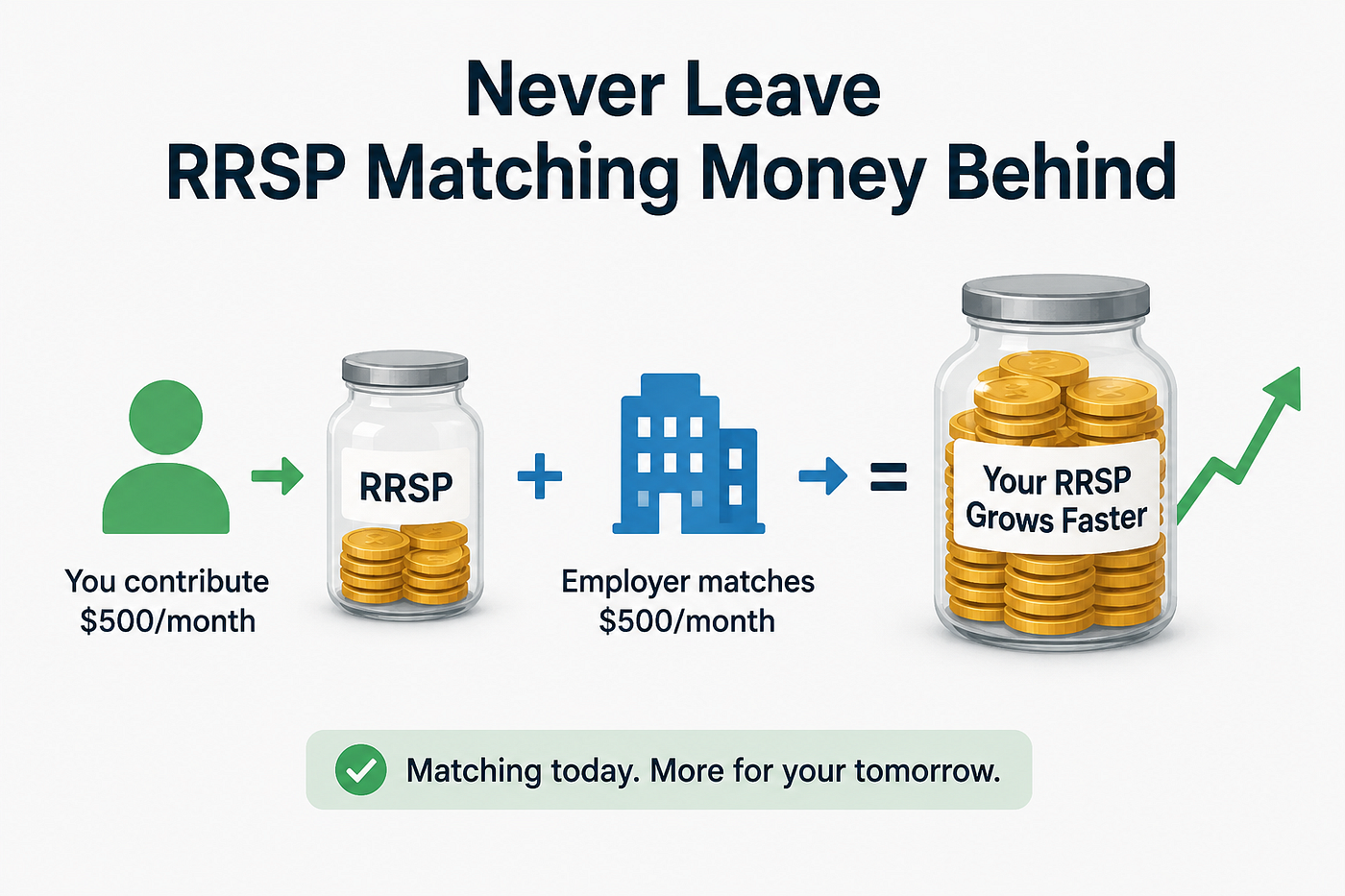
Last week, I met John at a party. We were having a casual conversation when he mentioned something interesting. His company offers a 5% RRSP matching program, but he does not use it.
I asked him why.
John said his annual salary is $120,000. His company allows him to contribute up to 5% of his income to the RRSP, and they will match it. That works out to $6,000 a year, or about $500 a month.
He explained his situation: His net monthly income is about $7,278 after taxes, CPP, and EI deductions. His monthly expenses are almost the same, so there is no extra money left at the end of each month to participate in the RRSP program.
It felt like John was leaving $500 of free money on the table. I kept thinking there must be a way to fix it.
Running the Numbers
When I thought over the issue, the following possible solutions emerged:
1. Ask his family or friends to help cover the $500 monthly RRSP contribution, and pay them back later.
2. Take a $500 monthly loan from a bank, and slowly repay it over time. This could be done when he gets a raise, or if he reduces his expenses.
However, both of these ideas did not feel practical.
At this point, I wanted to understand the situation better, so I decided to run the numbers using a tax calculator.
At a $120,000 gross income in 2026 in Ontario, the taxes and deductions look like this:

Next, I added the RRSP contribution scenario.
I assumed John contributes $6,000 per year to the RRSP program, and his company matches it with another $6,000. This brings total RRSP contributions to $12,000. Because the company’s match counts as a taxable benefit, his total gross income effectively increases to $126,000.
When I ran these numbers through the tax calculator, the result surprised me.

John’s net monthly take-home pay is reduced by just $306. If he can accommodate this modest reduction, $12,000 will be contributed to his RRSP each year, where it can continue growing tax-deferred for decades. For many people, a $306 monthly reduction in take-home pay is a small price to pay for $12,000 in annual retirement savings. And, all that RRSP money will continue to grow tax-deferred for decades!
Conclusion
An employer-matching RRSP program is an opportunity you shouldn’t leave on the table. By making a minor near-term sacrifice, you secure a powerful, tax-deferred portfolio for your future. The long-term return on investment far outweighs the small impact on your current cash flow.
Disclaimer: This article is for educational purposes only and is not financial or tax advice. Please consult a qualified tax or financial professional before making any decisions.
What are your thoughts on this post? Share your comments with us.
Stay ahead of the curve. Subscribe here to get notified whenever I publish a new guide or tool.
Share your comment or feedback. We'll get back to you as soon as we can.