A Beginner's Guide to Investing (Part 11): Group RRSP and Employer RRSP Match
How Group RRSPs Work and How Employer Matching Can Boost Your Retirement Savings
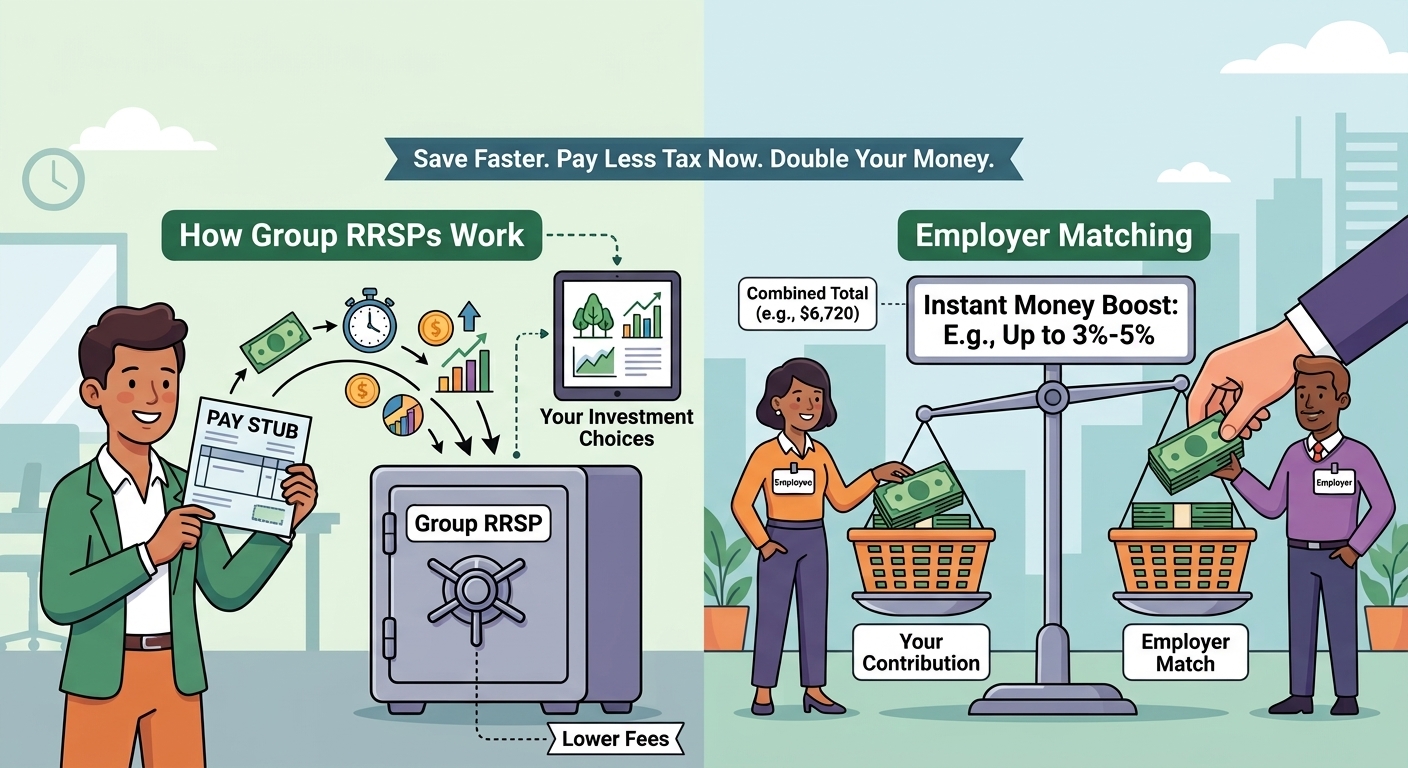
In Part 7, Part 8 and Part 9, we covered the basics of an RRSP, withholding taxes on RRSP withdrawals and spousal RRSPs. In this article, we will explore other important topics: group RRSP and employer RRSP matching.
What is a Group RRSP
Saving for retirement through an individual RRSP requires you to open an account, decide how much to contribute, and choose how to invest the money. Some employees may not feel comfortable making these decisions and may never set up or contribute to an RRSP.
Others may open an RRSP but may not know how to choose suitable investments. They may end up choosing investments that are not appropriate for their situation or paying relatively high management and investment fees to financial institutions or wealth management companies.
A Group RRSP makes saving for retirement easier by providing a workplace program where:
- Contributions are made directly and automatically from your paycheque.
- A curated list of investment options is provided through the plan.
- Investment management fees are often lower than those for individual accounts because of employer-negotiated group rates.
How Does a Group RRSP work
Group RRSPs are offered and administered by financial institutions such as banks, investment firms, and insurance companies. Your employer enters into an agreement with a financial institution to manage the Group RRSP for its employees.
- Administration Fees: The financial institution charges fees to manage the plan. Depending on the agreement, these fees may be paid by the employer, the employee, or shared between both.
- Participation: Joining a Group RRSP is generally optional. You decide whether to participate and how much to contribute, subject to the plan rules.
- Payroll Deductions: Once you join, your authorized contribution is automatically deducted from each paycheque.
- Immediate Tax Relief: Unlike individual RRSPs where you wait for a refund at tax time, Group RRSP contributions are deducted from your income before income tax is calculated. This means you pay less income tax on every single paycheque right away.
Investment Choices
When you join a Group RRSP, you are usually offered a range of pre-selected investment options, such as conservative, balanced, or growth portfolios.
- Example A: You can choose to invest 100% of your contributions into a balanced portfolio.
- Example B: You can split your contributions — for instance, putting 30% into a conservative portfolio and 70% into a growth portfolio.
- Flexibility: You can usually change your investment choices over time as your goals, timeline or risk tolerance change.
What is an Employer RRSP Match
To encourage employees to save for retirement, many employers offer an employer RRSP match as an additional benefit in their Group RRSP plan. The employer may match your contributions dollar for dollar (a 100% match) or may contribute 75 cents or 50 cents for every $1 you contribute.
The employer will usually match your RRSP contributions only up to a certain percentage of your pay. For example, the employer may match your contributions only up to 3% of your pay, even if you contribute 5% of your paycheque to the Group RRSP. Employer RRSP matching contributions are generally between 2% and 5% of the employee’s salary.
These details are usually set out in the Group RRSP plan documents. If you are already a member of a Group RRSP or are considering joining one, review the plan conditions carefully to understand how the employer match works.
Employer RRSP Matching Scenarios ($60,000 Annual Salary)
The table below shows how different matching rates and contribution levels affect your total savings based on an annual salary of $60,000:
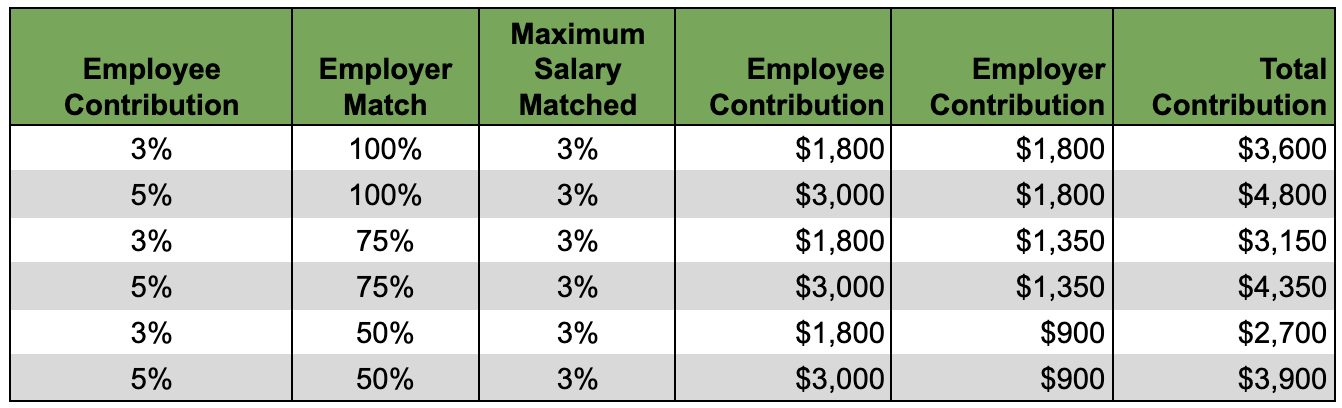
Key Takeaway: If you earn $60,000 and your employer matches 100% of your contributions up to 3% of your salary, you need to contribute $1,800 (3% of $60,000) to receive the maximum employer contribution of $1,800. If you contribute more than $1,800, the additional contribution will not receive an employer match.
Employer RRSP Contributions Use Your RRSP Contribution Room
When your employer contributes to your Group RRSP, this counts toward your RRSP contribution room, just like your own contributions. This means you need to have enough available RRSP contribution room to accommodate both your contributions and your employer’s contributions.
For example, assume that your gross salary is $84,000 per year and your RRSP contribution room, as shown on your CRA Notice of Assessment, is $14,000. If your employer offers a 100% RRSP match up to 4% of your salary and you contribute 4% of your salary, your RRSP contributions would look like this:
- Your RRSP contribution: 4% of $84,000 = $3,360.
- Your employer’s matching RRSP contribution: $3,360.
- Total Group RRSP contribution: $6,720.
In this case, your Group RRSP uses $6,720 of your $14,000 available limit. This leaves you with $7,280 of available RRSP contribution room for any individual RRSP contributions outside of work.
Withdrawals from Group RRSP
The rules for withdrawing money from a Group RRSP depend on the plan's terms. In some plans, you may be able to withdraw both your own contributions and your employer’s contributions while you are still employed. In other plans, the employer’s contributions may have restrictions.
When you leave your employer, you will generally have options for dealing with your Group RRSP. Depending on the plan, you may be able to leave the money in the Group RRSP, transfer it to another RRSP or withdraw the money (withholding tax is generally applicable).
Withdrawals from a Group RRSP are generally taxable, and withholding tax is normally applicable. However, withholding tax is not applicable to withdrawals under the Home Buyers’ Plan (HBP) and Lifelong Learning Plan (LLP), provided you meet the requirements of these programs.
Why an Employer Match is So Valuable
An employer RRSP match can help you build retirement savings faster because your employer is contributing additional money to your RRSP.
For example, if your employer matches your contribution dollar for dollar, every $1,000 you contribute can result in another $1,000 being contributed by your employer, up to the matching limit. In other words, your $1,000 contribution can immediately become $2,000 in your Group RRSP before any investment growth.
This can make a Group RRSP with an employer match a valuable workplace benefit. Taking full advantage of an available employer RRSP match is generally recommended by financial planners because it allows you to receive the additional contribution from your employer. If you are eligible for a match, understand the matching rules and consider contributing enough to receive the maximum employer contribution, if it fits your overall financial situation.
A Note for Lower-Income Earners
If you expect to have a relatively low income in retirement and expect to receive Guaranteed Income Supplement (GIS), you should also consider how RRSP/RRIF withdrawals may affect government benefits, as RRSP/RRIF withdrawals are considered income and will reduce your GIS payments.
This does not necessarily mean that a lower-income earner should avoid an employer-matched Group RRSP, as the employer match provides an additional contribution to your retirement savings. However, low-income earners may want to consider a strategy to enter retirement at age 65 with a low RRSP/RRIF balance. For example:
- Do not contribute more than the amount needed to receive the maximum employer match.
- Consider withdrawing money from the Group RRSP while employed or when you leave the employer, to the extent permitted by the plan rules. You will need to pay tax on the amount withdrawn. You could then invest the withdrawn amount in a TFSA, if you have available contribution room.
- If you still have money in your RRSP as you approach age 65, consider withdrawing some or all of it before age 65. You will need to pay tax on the amount withdrawn, but reducing your RRSP balance may help you qualify for a higher GIS payment in retirement.
Things to Understand Before Participating
Before joining a Group RRSP, it is important to understand the rules of the plan. Pay particular attention to:
- Employer matching: Understand how much your employer will contribute and the maximum amount they will match.
- Investment choices: Review the available investment options and their fees before deciding where to invest your contributions. Ensure that the plan offers investment options that match your current and future investment needs.
- Withdrawal rules: Understand when you can withdraw your own contributions and whether there are restrictions on employer contributions.
- What happens when you leave: Find out what options you have for your Group RRSP when you leave your employer.
- RRSP contribution room: Remember that both your contributions and your employer’s contributions use your available RRSP contribution room.
Conclusion
Generally, it makes sense to take advantage of an employer’s RRSP matching program, particularly when the employer offers a 100% match. However, make sure you understand the plan’s investment choices, fees, withdrawal rules and other conditions before participating.
Also See: Never Leave RRSP Matching Money Behind
Disclaimer: This article is for educational purposes only and is not financial or tax advice. Please consult a qualified tax or financial professional before making any decisions.
What are your thoughts on this post? Share your comments with us.
Stay ahead of the curve. Subscribe here to get notified whenever I publish a new guide or tool.
Share your comment or feedback. We'll get back to you as soon as we can.