A Beginner's Guide to Investing (Part 17): RRSP vs. TFSA Can Be a Gray Area
Your financial circumstances change over time — and so should your RRSP vs. TFSA strategy
In Parts 15 and 16 of the Beginner’s Guide series, we compared RRSP and TFSA strategies for low- and middle-income Canadians, respectively, assuming they invest the same pre-tax income in either account over 40 years. But life doesn’t always go according to plan. A lot can change over 40 years.
For example:
- Your income may increase as your career advances.
- You may switch jobs, and your new employer may or may not offer an RRSP matching program.
- You may decide to direct your savings towards other goals, such as buying your first home through an FHSA or saving for your children’s education through an RESP.
- You may buy a home and direct more of your savings toward paying off the mortgage.
- Your expenses may increase, leaving you with little or no money to save for a few years.
- You may lose your job, remain unemployed for a year or two, or struggle to find another job.
- You may decide to retire early.
These, along with many other changes in your life, can influence whether an RRSP or TFSA is the better choice at a given point in time. The choice you make today may not necessarily be the right one a few years down the road.
Let’s look at a few situations where the choice between an RRSP and TFSA may change over time.
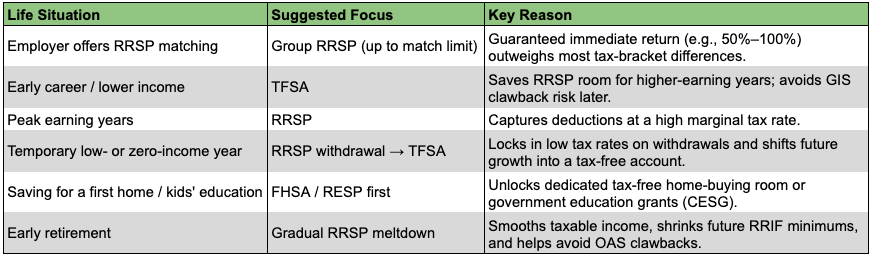
Employer RRSP Matching — Don’t Leave Free Money Behind
For low-income earners, investing in a TFSA is generally preferred over an RRSP because of its flexibility and the fact that TFSA withdrawals do not affect GIS (Guaranteed Income Supplement) eligibility or payments during retirement (age 65+). However, an employer RRSP matching program, particularly one offering a 100% match, should never be ignored.
For example, if your employer offers a 100% RRSP match on your contributions up to $2,000, your $2,000 contribution becomes $4,000 immediately, thanks to the additional $2,000 contributed by your employer. Although RRSP withdrawals are fully taxable, receiving an immediate 100% employer match is a substantial benefit that is too good to ignore.
As you approach retirement, you can review your RRSP portfolio and consider whether making withdrawals during lower-income years makes sense. Withdrawals before age 65 may help reduce your future RRSP/RRIF balance and potentially protect GIS payments in retirement. Remember that GIS eligibility and payments depend on income, including your spouse’s income if you have one, not just your income alone.
Similarly, middle- and high-income earners should not leave employer RRSP matching contributions on the table. However, as they approach retirement, they should review their accumulated RRSP savings and consider whether withdrawing some of the money over the last few years of employment makes sense. This RRSP meltdown strategy can help reduce the RRSP balance before it is converted into a RRIF, thereby lowering future mandatory minimum withdrawals. It may also help reduce the risk of facing higher taxes or OAS recovery tax during retirement.
Also, if you change jobs and your new employer does not offer an RRSP matching program, it may be worth revisiting your RRSP vs. TFSA strategy. Without an employer match, the decision should be based on factors such as your current and expected future marginal tax rates, retirement income, and eligibility for income-tested government benefits. Without an employer match, the reasons for favouring an RRSP over a TFSA may no longer apply.
Note: Before taking advantage of an employer RRSP matching program, check the plan’s terms and conditions. Some plans require you to remain employed for a specified period before the employer’s matching contributions become fully vested. If you leave the company before meeting that requirement, you may lose some or all of the employer-matched amount.
As Your Income Changes, So Should Your RRSP vs. TFSA Strategy
Your employment income may change significantly over your working years, which can span three or four decades. As you gain experience, you may receive a promotion or find a higher-paying job with a new employer. On the other hand, you may lose your job, and your next job may pay less than your previous one.
Suppose your annual employment income increases from $50,000 to $90,000. When you were earning $50,000, directing your savings towards a TFSA may have made more sense. Now that your income has increased to $90,000, it may be worth re-evaluating your strategy to see if RRSP contributions offer greater tax benefits. Remember, unused RRSP contribution room carries forward indefinitely. So, if you prioritized your TFSA in earlier years instead of contributing to your RRSP, you haven’t lost that RRSP contribution room. You can use it in a future year when an RRSP contribution may provide greater tax savings.
Similarly, if you lose your job and your new job pays significantly less, your RRSP contribution may generate relatively little tax savings because you are now in a lower tax bracket. In that situation, you may prefer to direct your savings towards your TFSA instead, particularly if you expect your income to increase again in the future or anticipate needing access to your savings.
Note: If you expect your income to increase significantly in the next year or two, you can contribute to your RRSP now but defer claiming the tax deduction until a future year when it may provide greater tax savings. I have discussed this in more detail in my article on the Registered Retirement Savings Plan (RRSP).
When Your Income Drops, Consider Moving RRSP Savings to a TFSA
During your working years, you may experience periods when you have little or no employment income. This could happen if you lose your job, take time off to raise children, return to school for higher education, or take a career break for other reasons.
If you have accumulated savings in your RRSP during earlier, higher-income years, this may be an opportunity to withdraw some of that money at a relatively low tax rate and contribute the after-tax proceeds to your TFSA.
For example, suppose you earned $100,000 annually and contributed to your RRSP during those years. You subsequently take two years off work to pursue higher education, resulting in little or no income. During this period, you could consider withdrawing some of your RRSP savings, paying applicable tax, and moving the remaining amount into your TFSA, provided you have sufficient TFSA contribution room.
Note: At an annual income of $100,000, an RRSP contribution could save you approximately 30% in taxes. If you withdraw $50,000 from your RRSP in a year when you have no other income, the average tax payable could be less than 15%. This illustrates why withdrawing RRSP savings during temporarily low-income years can be an effective tax-planning strategy. Actual tax savings and taxes payable will depend on your province or territory of residence and individual circumstances.
Once the money is in your TFSA, future investment growth and withdrawals are tax-free. You also gain greater flexibility because TFSA withdrawals do not increase your taxable income or affect income-tested government benefits such as GIS.
Furthermore, reducing your RRSP balance during these lower-income years can help reduce future mandatory RRIF withdrawals and the associated tax burden during retirement.
When Other Financial Priorities Take Precedence
Retirement savings aren’t always your top financial priority. At different life stages, you may have other goals that require you to direct your savings elsewhere.
For example:
- Buying your first home: If you qualify for an FHSA (First Home Savings Account), contributing to it may take priority over additional RRSP or TFSA contributions. An FHSA offers a tax deduction for contributions and tax-free withdrawals for qualifying home purchases. Even if you ultimately decide not to buy a home, you can transfer your FHSA savings into your RRSP tax-free without using up your existing RRSP contribution room.
- Saving for your children’s education: RESP contributions may be attractive because of government grants, particularly if you qualify for the Canada Education Savings Grant (CESG).
- Paying off your mortgage: Once you buy a home, you may decide to direct more of your savings toward paying down your mortgage instead of investing in an RRSP or TFSA. The decision may depend on your mortgage interest rate, expected investment returns, and comfort with debt.
Early Retirement
Although Canada has no official retirement age, 65 is often considered the traditional retirement age, as that is when you become eligible for Old Age Security (OAS). However, if you decide to retire earlier, say at age 60, you may have several years before starting CPP and OAS, particularly if you choose to defer both pensions.
These years can provide an opportunity to withdraw money from your RRSP at relatively lower tax rates, particularly if you no longer have employment income. This strategy is often referred to as an RRSP meltdown. By gradually drawing down your RRSP during these lower-income years, you can reduce the balance that will eventually be converted into a RRIF, thereby lowering future mandatory minimum withdrawals.
Lower RRIF withdrawals during retirement may also help reduce the possibility of triggering OAS recovery tax. You can contribute the after-tax proceeds from your RRSP withdrawals to your TFSA, provided you have sufficient contribution room. This allows the remaining funds to grow tax-free and gives you greater flexibility to withdraw money during retirement without increasing your taxable income.
Conclusion
Your RRSP vs. TFSA strategy is an important part of your overall financial plan. As your life progresses and your financial circumstances change, you should revisit and fine-tune your plan, including whether directing your savings towards an RRSP or TFSA makes more sense in the short, medium, and long term. At times, it may even make sense to withdraw money from your RRSP and move the after-tax proceeds into your TFSA.
The ultimate goal is to minimize your lifetime taxes while maximizing government benefits, particularly during retirement, so you can make the most of your hard-earned savings.
Check out other articles in this series:
1. A Beginner’s Guide to Investing
2. RRSP vs. TFSA for Low-Income Canadians
3. RRSP vs. TFSA for Middle-Income Canadians
Disclaimer: This article is for educational purposes only and is not financial or tax advice. Please consult a qualified tax or financial professional before making any decisions.
What are your thoughts on this post? Share your comments with us.
Stay ahead of the curve. Subscribe here to get notified whenever I publish a new guide or tool.
Share your comment or feedback. We'll get back to you as soon as we can.