Saving: The First Step Toward Financial Security
Simple Habits That Can Help You Build Financial Security
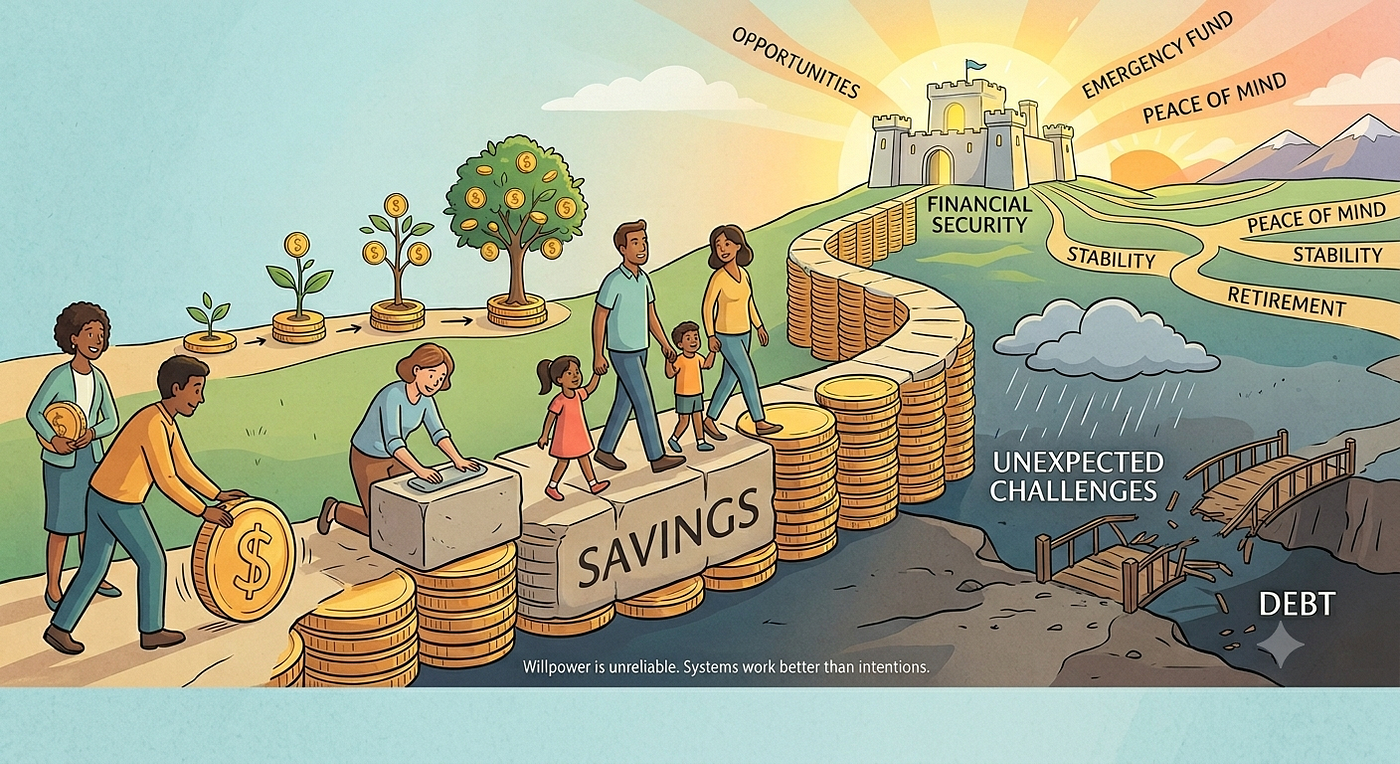
You’ve likely heard the advice before:
Saving is the foundational first step toward financial security.
But if you currently have a secure, well-paying job that easily covers your expenses, you might wonder: Why bother?
The days of having one secure job for life are mostly gone. In the past, many people could start working for a company, stay there for decades, and retire with a guaranteed pension. While a small number of jobs still offer that kind of stability — mainly in the government sector — most workers today do not have that level of security. Many employees can lose their jobs with little or no warning as companies respond to changing economic conditions, new technologies, and shifting business needs. The rise of artificial intelligence has added to this uncertainty, as some jobs are being automated and many workers are unsure how their roles may change in the future.
Why Savings Matter
Imagine you are getting ready for work one morning when you receive an email from your employer. Due to a company restructuring, your position has been eliminated. The company offers you three months of severance pay.
Three months may seem like plenty of time. But what if you cannot find another job that pays a similar salary before the severance runs out? How will you pay your mortgage or rent, buy groceries, and cover your other monthly expenses?
For most people, this situation would be stressful. Without savings, even a temporary loss of income can quickly become a financial crisis. You may be forced to rely on credit cards, lines of credit, or loans just to cover basic expenses. This can lead to debt building up fast, making an already difficult situation even harder.
Savings Provide a Financial Safety Net
Savings act as a financial safety net. They give you time to look for a new job and deal with unexpected expenses without immediately going into debt.
Job loss is only one reason to save. Life can throw many unexpected challenges our way when we least expect them:
- A major car repair
- A home repair, such as a broken furnace, air conditioner or leaking roof
- An illness or injury that keeps you from working
- A family emergency
- Unexpected increases in living costs, such as a higher mortgage payment after renewing your mortgage
Having money set aside won’t prevent these events from happening, but it can make them much easier to manage.
Savings Help You Achieve Future Goals
Saving is not only about protecting yourself from unexpected events. It is also about preparing for important future goals. For example, you may want to save for a down payment on your first home, your children’s education, or your retirement.
While government programs such as CPP and OAS can provide some retirement income, they may not be enough to maintain your current lifestyle. Saving and investing during your working years can help provide greater financial security and more choices later in life.
Savings can also reduce stress and provide peace of mind during difficult times.
That is why saving is not just about building wealth. It is about creating financial security and giving yourself more choices when life doesn’t go according to plan.
Why Many People Struggle to Save
Most people already know they should save, just as most people know they should exercise more and eat healthier.
The challenge is not knowing what to do. The real challenge is doing it consistently.
If saving is so important, why do so many people struggle to do it?
One reason is that we naturally value immediate rewards more than future benefits.
Saving money is, in a sense, a choice between your “present you” and your “future you.” When you save, you are taking money away from your current spending and setting it aside for your future self — and often for the people you care about too.
Imagine you have an extra $100. You could put it into savings, or you could spend it on a dinner out, a new gadget, concert tickets, or something else you would enjoy today.
The benefit of spending the money is immediate. The benefit of saving it may not be seen until months or even years later.
Because today’s rewards are easier to see, many people naturally choose to spend rather than save.
As a result, many people tell themselves they will start saving later — after they get a raise, pay off some debt, or reach another financial milestone. Unfortunately, “later” often never arrives. As income increases, expenses tend to increase as well.
Many people also feel they do not earn enough to save. After paying for housing, food, transportation, utilities, and other necessities, there may be very little left at the end of the month. In such situations, saving can feel unrealistic or even out of reach.
Even when some money is available, small amounts can feel insignificant. A person may wonder, “What difference will saving $25 or $50 a month really make?”
The reality is that successful saving is usually not about making one large deposit. It is about building a habit and saving consistently over time.
How to Start Saving (Even If It Feels Difficult)
Before we talk about practical ways to save, it is important to understand one key idea: saving is not just about methods or tools. It starts with mindset.
A useful comparison is weight loss. If someone keeps saying, “I want to lose weight,” but does not change their eating habits or lifestyle, nothing really changes. Even strict crash diets may work for a short time, but they rarely lead to lasting results unless there is a real change in daily habits.
Saving works similarly.
Strategies, budgets, and apps help, but only if you are committed to saving regularly. In other words, saving needs to become a priority in your financial life, not just a wish for the future.
This does not mean being perfect. It means you make a simple decision: saving is important enough that you will keep trying, even if it feels difficult at times.
Once this mindset is in place, the practical steps that follow become much more effective and easier to stick with.
The good news is that once your mindset is focused on saving, it does not have to feel painful or complicated.
How to Start Saving in Practice
1. Start Small, but Start Today
Many people delay saving because they think they need a large amount. That usually leads to doing nothing.
A better approach is:
- Start with whatever feels easy: $25, $50, or $100 per paycheque
- The amount is less important than building the habit
A common saying in personal finance is:
The best time to start saving was 20 years ago. The second-best time is today.
You cannot change the past, but you can take a small step today. Even a small start is better than waiting for the “right time.”
Key message: Don’t wait for the “right amount.” Start with what you can manage today.
2. “Pay Yourself First”
Most people save whatever is left at the end of the month. The problem is — there is often nothing left.
Instead:
- Treat saving like a bill you must pay.
- Move money into savings as soon as you get paid.
In fact, this idea is not unusual in everyday life. For example:
- Many people regularly donate a fixed amount or percentage of their income to a place of worship or a charity they support.
- Taxes are also automatically deducted from your paycheque before you even receive your income.
In both cases, the money is set aside before it can be spent.
Saving can work in the same way. You simply make it a priority deduction from your income.
You do not need to start big. You can begin with a small percentage — such as 2%, 3%, 5%, or 10% of your paycheque — and increase it gradually over time as your comfort level grows.
When you receive a pay raise, try not to increase your spending right away. Instead, consider increasing your savings percentage. This way, your standard of living can stay steady while your savings grow faster.
Simple explanation:
Save first, spend what remains — not the other way around.
3. Take Advantage of Employer RRSP Matching
If your employer offers an RRSP matching program, it is one of the easiest ways to grow your savings faster.
In simple terms, your employer may add money to your retirement savings every time you contribute. For example, if you contribute a certain percentage of your salary, your employer may match part or all of that amount, up to a limit.
Many employers offer matching programs such as 3%, 4%, 5%, or even higher of your salary, depending on the company policy. The exact percentage varies, but the idea is the same: the more you contribute (within the limit), the more your employer contributes as well.
This is essentially free money. If you do not take advantage of it, you are leaving part of your compensation unused.
Think of it this way:
- If you contribute $100 and your employer matches $100, your savings immediately become $200.
- Very few other financial decisions give you an instant return like this.
That is why, if such a program is available, it should usually be one of your first priorities before investing elsewhere.
To get the full benefit, make sure you contribute enough to receive the full match. If you contribute less than the required amount, you may miss out on part of the benefit.
Simple explanation: Employer matching is one of the easiest ways to grow your savings faster. Try to contribute at least enough to get the full match whenever possible.
4. Automate Your Savings
Willpower is unreliable. Systems work better than intentions.
The easiest way to save is to automate it. You can do this by setting up an automatic transfer with your bank so that a specific amount of money moves from your checking account to a separate savings account every single payday.
This ensures that saving happens first, before you have a chance to spend the money on something else.
If your employer offers a retirement matching program (like an RRSP match), you may already be doing this without realizing it. Your contributions are automatically taken from your paycheque, and your employer adds their matching contribution at the same time. Because that money goes straight into your retirement savings, you never even see it in your regular bank account.
This removes effort, delays, and the temptation to skip saving.
Why this works:
- No decision fatigue: You don’t have to make a choice every single month.
- Out of sight, out of mind: It removes the temptation to spend money that “looks” available.
- Creates a habit: It turns saving into a background routine, not a chore you have to keep repeating.
Over time, automation builds consistency — and consistency builds savings.
5. Start With One Clear Goal
Saving feels easier when it has a purpose. Instead of just thinking “I should save,” it helps to be clear about what you are saving for.
Examples:
- Emergency fund
- Next car
- Home repairs or saving for a down payment on a first home
- Education for children
- Vacation
- Retirement
A savings goal makes saving feel more real. You are building toward something specific.
Without a goal, savings feel abstract. With a goal, it feels meaningful and easier to stick with.
6. Don’t Aim for Perfection
Saving is not a straight line. Some months you may save less than planned — or nothing at all. That is normal.
Life happens. Unexpected expenses come up. Income may vary. There will be good months and difficult months.
What matters more than perfection is:
- Consistency over time
- Getting back on track quickly when you can
If you miss a month, it does not mean you have failed. It simply means you continue from where you are.
Key idea: Saving is not about being perfect. It is about not giving up.
7. Increase Slowly Over Time
Once saving becomes a habit, you can gradually improve it.
For example:
- When you get a salary increase, try increasing your savings at the same time instead of increasing spending
- When you finish paying off a loan or major expense, redirect that money into savings
Even small increases make a big difference over time. Because saving builds on itself, these small changes can grow into meaningful progress in the long run.
The key is not big sudden changes. It is small, steady improvements over time.
Key Takeaways
Saving is less about income and more about habits, mindset, and consistency. Here are the main points from this article:
- Most people already know they should save, but find it difficult to turn that knowledge into action.
- Saving often fails because we focus more on today’s needs than future needs.
- The solution is not willpower alone, but building simple systems that make saving automatic.
Practical steps you can follow:
- Start small, but start today
- Pay yourself first before you spend
- Use employer RRSP matching if it is available
- Automate your savings so you do not rely on memory or discipline
- Start with one clear goal to make saving meaningful
- Do not aim for perfection — focus on consistency
- Increase your savings gradually over time when your income grows
You do not need to do everything at once. Start with one or two changes and build from there.
The goal is not perfection. The goal is steady progress
Disclaimer: This article is for educational purposes only and is not financial or tax advice. Please consult a qualified tax or financial professional before making any decisions.
What are your thoughts on this post? Share your comments with us.
Stay ahead of the curve. Subscribe here to get notified whenever I publish a new guide or tool.
Share your comment or feedback. We'll get back to you as soon as we can.