Applying for OAS: My Frustrating Journey Through Service Canada’s Maze
What I learned while trying to claim the benefits I’d earned — and why Canada needs to make it easier for seniors to get help.
I moved to Canada in 1997 and gradually became familiar with two major government benefits — Old Age Security (OAS) and the Canada Pension Plan (CPP) — both administered by Service Canada.
The OAS pension begins at age 65, but one can choose to delay receiving it in exchange for larger payments later. The pension can be delayed up to 60 months, increasing by 0.6% per month — up to 36% more if delayed the full five years.
Starting My Application
I had read many stories about how complicated and slow the OAS process can be. Service Canada generally mails an application package to residents around their 64th birthday and advises them to apply roughly 11 months before they want payments to begin.
I received my package in early November 2024 and decided to apply online through My Service Canada Account (MSCA). I had heard that paper applications, even when submitted in person, take much longer to process.
To my relief, the online application was fairly straightforward, and my OAS approval came within three months. My first payment was scheduled for November 2025.
So far, so good — or so I thought.
A Change of Heart
By October 2025, I was eagerly awaiting my first OAS payment. At the same time, I began doing more research about the benefits of delaying OAS.
After reassessing my finances, I realized it would be smarter to defer my pension for the full 60 months to maximize future payments.
But could I still make this change — just weeks before my first payment?
After hours of searching online (and even consulting ChatGPT and Google Gemini), I learned that it might be possible to withdraw or delay an approved application.
I logged in to my MSCA account and searched everywhere for an option to change my start date — no luck.
Calling Service Canada (Round One)
I called Service Canada and waited on hold for nearly 20 minutes before finally reaching an agent.
Unfortunately, the agent couldn’t guide me to the right section on the website. After another 10 minutes of trying, we gave up.
The agent advised me to send a written request to Service Canada — either by mail or in person — and warned that it could take up to six months to process.
During that time, I might continue receiving OAS payments, which I would then have to return.
Finding the “Hidden” Option
Later, while exploring MSCA again, I stumbled across an option labeled “Withdraw Old Age Security Pension Request” buried deep in an unrelated section.
Finally! I thought I was on the right track.
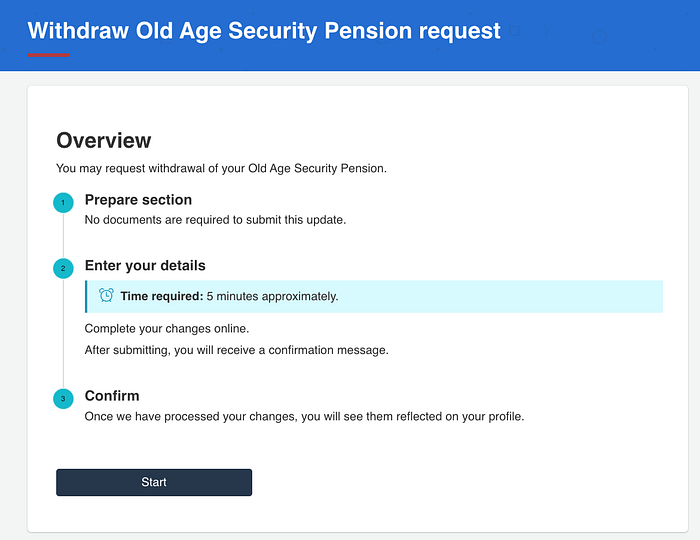
But when I clicked Start, I was met with a message saying that my application couldn’t be withdrawn.
Back to square one.
Calling Service Canada (Round Two)
The next day, I called again. Another 20-minute wait, another round of security questions, and another patient explanation of my request.
This agent confirmed my fears: once an OAS application is approved, the start date cannot be changed online. Even agents have no authority to withdraw it from their terminals.
“Please be patient,” the agent said kindly. “This takes time.”
The only option was, once again, to send a written request, which would be manually processed in about six months.
Going In Person
Determined to resolve the issue, I drafted a detailed letter requesting to delay my OAS start date.
Mailing it felt risky due to Canada Post’s partial strike, so I decided to visit my local Service Canada office, about 10 km away.
After waiting 45 minutes in line, I handed my letter to an official. He told me the same thing: it could take 3–6 months to process, and I should set aside any OAS payments I receive in the meantime to repay later.
He explained that once I returned those payments, my file would be treated as though I had never applied, and I would have to reapply when I actually wanted to start OAS — ideally at least six months before.
That conversation left me shaking my head.
A Broken System
As an IT professional, I simply cannot understand why the process needs to be so complicated. Changing a start date — especially before any payment has been made — should be trivial in a modern system.
In the private sector, such a change would take seconds, not months.
In the systems I’ve worked on, it’s just a matter of switching a status from Active to Hold, or modifying a date field.
Unfortunately, when dealing with a government department, we have no alternative provider to turn to. It’s as if Service Canada designed its online systems decades ago and never updated them.
Perhaps in the pre-digital era, such requests were handled manually through letters and supervisor approvals — and that same outdated process has been replicated in software. Or maybe, just maybe, the complexity helps justify jobs.
All I want is for Service Canada to modernize its systems — not fancy UX redesigns, but simply the ability for users to make basic changes online without months of waiting.
My Advice for Future OAS Applicants
- Check if you’re automatically enrolled.
Some Canadians are automatically approved for OAS and don’t need to apply. If you’re automatically enrolled and plan to start payments at 65, you don’t need to do anything. But if you want to delay OAS, contact Service Canada as soon as possible, but at least one month before payments begin. - If you must apply, decide your start date carefully.
The online application includes a section to specify your desired start date. Think it through — once approved, changing it is extremely difficult. - Apply online, not by paper.
Online applications are processed much faster than paper ones, and you can track progress through your MSCA account. - Avoid last-minute changes.
Once your application is approved, it’s better not to change your start date. If you must, be prepared for a lengthy, manual process.
Final Thoughts
I never imagined that applying for the OAS pension would feel like navigating a maze. Service Canada’s staff were polite but constrained by an outdated system.
For a country that prides itself on digital progress and senior care, it shouldn’t be this hard for retirees to make a simple change online.
Canada can — and must — do better.
What are your thoughts on this post? Share your comments with us.
Stay ahead of the curve. Subscribe here to get notified whenever I publish a new guide or tool.
Share your comment or feedback. We'll get back to you as soon as we can.