A Beginner's Guide to Investing (Part 13): Invest in Dividend Stocks or Growth Stocks?
Dividend income, growth potential, and why total return matters more than yield
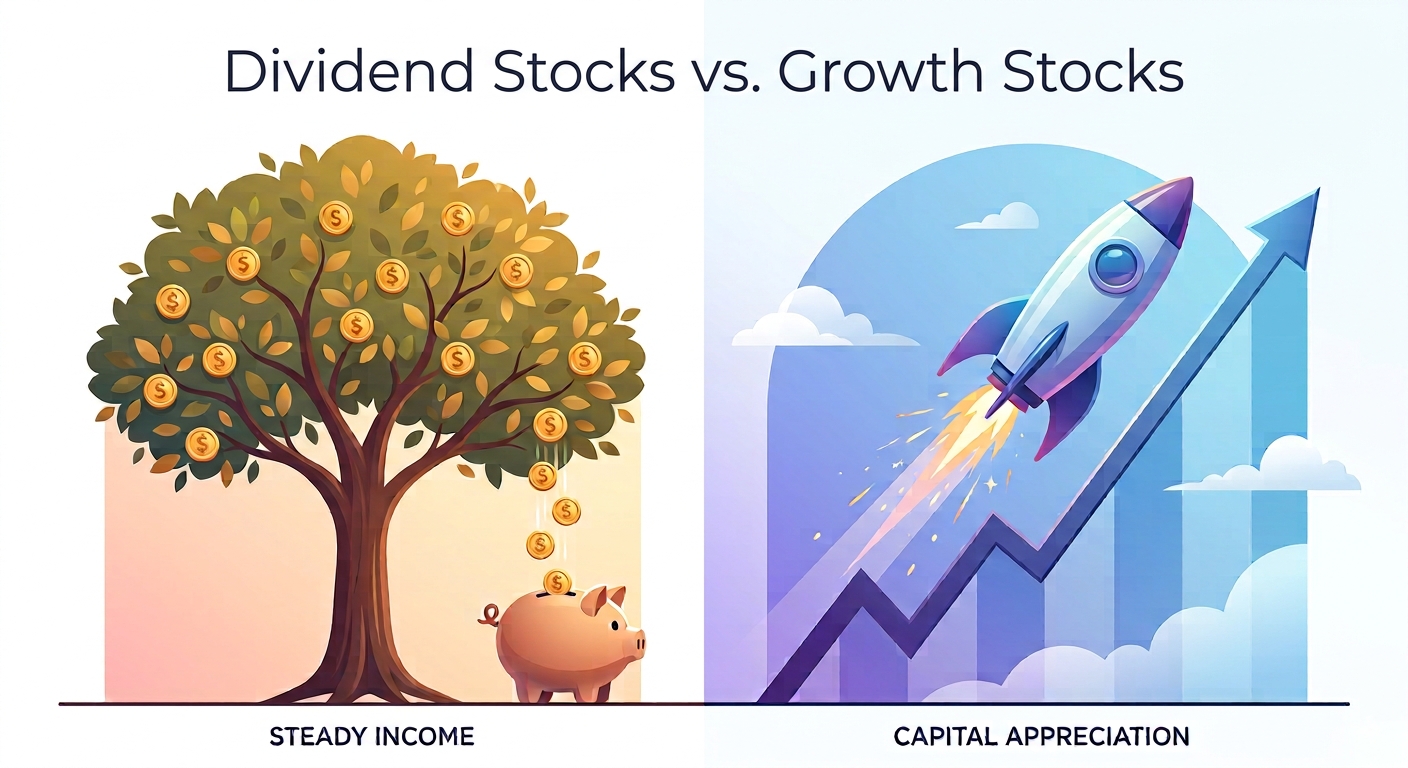
When a company generates a profit — that is, it has money left over after paying its operating expenses — it has several choices for what to do with that money. Two common choices are:
- Return a significant portion of the profit to shareholders through dividends.
- Retain most of the profit and reinvest it in the business to fund future growth.
Of course, many companies follow a hybrid approach. They may return some profits to shareholders through dividends while retaining and reinvesting the rest to grow the business.
Both approaches can work well for investors. Dividend-paying companies can provide a stream of income, while companies that reinvest profits can potentially grow faster and increase share value.
The problem is not choosing one approach over the other. The problem is blindly following one approach and assuming it is always better.
In this article, we will look at dividend stocks and growth stocks, their advantages and disadvantages, and why investors should focus on the overall return from an investment rather than simply whether a company pays a dividend.
What is a Dividend?
In simple terms, a dividend is a payment a company makes to its shareholders from the money it earns. For example, if you own 100 shares of a company and it pays a dividend of $1 per share, you receive $100.
In other words, think of a dividend as a company sharing some of its profits with its owners — the shareholders.
Dividends are usually deposited into your brokerage account as cash. Most companies pay dividends quarterly, but some companies pay them monthly, semi-annually, or annually.
Note: A company can pay dividends from its current year’s profits, but it can also use accumulated earnings or other available cash to pay dividends.
What is a Dividend Yield?
One term that is closely related to dividends is dividend yield, which is an important measure for investors who invest in dividend-paying stocks.
In simple terms, the dividend yield tells you how much annual dividend income a stock pays as a percentage of its current share price. You can think of it as being somewhat similar to the annual interest rate on a Guaranteed Income Certificate (GIC).
For example, if you buy a GIC that pays 3% annual interest, you receive $3 in interest for every $100 invested. Similarly, if a stock is currently priced at $100 and pays an annual dividend of $4 per share, its dividend yield is 4%.

So, if a stock pays $4 in annual dividends and its current price is $100:

You don’t normally need to calculate the dividend yield yourself. Financial websites, such as Google Finance, Yahoo Finance and Morningstar, as well as your brokerage’s website or app, generally provide the current annual dividend and dividend yield for most publicly traded stocks.
Important: Unlike GIC interest, a dividend is not guaranteed. A company can reduce or eliminate its dividend.
Dividend yield is important when buying a stock because it shows the annual dividend income you would receive relative to the stock’s current price. However, once you have purchased the stock, your yield on cost does not change with stock price movements unless the company changes its dividend payout. For example, if you bought a stock for $100 and it pays an annual dividend of $4, your yield on cost is 4%. If the stock price later rises to $120, your yield on cost is still 4%, assuming the annual dividend remains $4.
Total Return: Dividend + Price Appreciation
When you invest in a stock, there are two main ways you can make money:
- Dividend income: the company pays you dividends while you own the shares.
- Price appreciation: the value of your shares increases.
Together, these make up the total return from the investment.
For example, suppose you buy 100 shares of a company at $100 per share, so your total investment is $10,000. During the year, the company pays a total dividend of $4 per share. You therefore receive $400 in dividends.
At the end of the year, the stock is trading at $105 per share. Your 100 shares are now worth $10,500, i.e a $500 increase in the value of your investment.
Your return is therefore:
- Dividend income: $400 = 4%
- Price appreciation: $500 = 5%
- Total return: $900 = 9%
In simple terms:
Total Return = Dividend Return + Price Appreciation
But price appreciation can also be negative.
For example, suppose you buy the same stock for $100 per share and receive a 4% dividend during the year. However, the stock price falls by 10% to $90 per share.
Your return would then be:
- Dividend income: +4%
- Price appreciation: −10%
- Total return: −6%
Although you received a dividend, your overall investment lost 6% in value.
This is why, when evaluating the performance of a stock, you should consider both the dividends you receive and the change in the value of the shares. Looking at only one of these can give you an incomplete picture of your investment’s performance.
The “Free Money” Myth
One common mistake beginners make is thinking of dividends as “free money” from the company.
It is easy to see why. You own a stock, and then a few days later, you see $20 of dividend income deposited into your brokerage account. It can feel like the company has simply given you an extra $20.
However, a dividend does not create wealth out of thin air. Imagine you own one share of a company trading at $100 and the company declares a $5 dividend.
When the dividend is paid, $5 of cash leaves the company and goes to you. The company now has $5 less cash, all else being equal. This is reflected in the value of the company, and the share price is adjusted downward by approximately the amount of the dividend when the stock goes ex-dividend.
So, ignoring market movements and other factors, you can think of your position as changing from:
- One $100 share
to approximately:
- One $95 share + $5 in cash
You haven’t received $5 of free money — a part of the value of your investment has been transferred from the company to you in the form of cash.
This is an important concept because dividends are only one part of your total return. What ultimately matters is the combination of the dividends you receive and the change in the value of your investment.
A High Dividend Yield Can Be a Trap
At first glance, a high dividend yield can look very attractive. If one company pays a 3% dividend while another pays an 8% dividend, you might naturally think that the 8% dividend is better.
But a high dividend yield does not necessarily mean that you have found a better investment. One reason is that dividend yield increases when the stock price falls, even if the company has not increased its dividend.
For example, suppose a company pays an annual dividend of $4 per share, and its stock is trading at $100; that is, its dividend yield is 4%. Now suppose the stock price falls to $50, but the company continues to pay the same $4 annual dividend — now the dividend yield is 8%.
The yield has doubled from 4% to 8%, but the share price has fallen by 50%. An investor who already owned the stock has lost half of the share value, although the investor continues to receive the dividend.
A falling share price can also be a warning sign that investors are concerned about the company’s future. Perhaps the company’s profits are falling, its debt is increasing, or its business is facing other challenges.
A Real-World Example
The Canadian telecommunications companies BCE and TELUS provide a good illustration of why investors should not look at dividend yield in isolation.
Both companies had long been popular among Canadian dividend investors. As their share prices declined, their dividend yields became increasingly attractive. For example, TELUS’s dividend yield increased from about 4.4% at the end of 2021 to about 9.25% at the end of 2025 as its share price declined from about $30 to $18, while dividend payout increased.
However, a high yield did not mean that the investment was risk-free or that the dividend was guaranteed. In July 2026, TELUS announced a 55% reduction in its quarterly dividend from about $0.42 to $0.19 per share, which further put downward pressure on its stock price, as investors don’t like dividend cuts.
BCE also provides an example of how a declining share price can result in a high dividend yield, which peaked at over 13% in May 2025 right before BCE announced a 55% dividend cut.
The lesson is not that BCE or TELUS were necessarily bad investments. Rather, it shows why a high dividend yield by itself should not be the main reason for buying a stock.
Is the Dividend Sustainable?
Another simple check is to see whether the company can comfortably afford its dividend.
For example, if a company earns $5 per share and pays $2 per share in dividends, it is paying out 40% of its earnings as dividends. If it pays $5 in dividends on $5 of earnings, it is paying out 100%.
A payout ratio above 100% — where the company pays more in dividends than it earns — can be a warning sign, particularly if it continues for several years.
The important point for an investor is: Don’t choose a stock simply because it has a high dividend yield.
A high yield can sometimes represent an attractive opportunity, but it can also be a warning that something is wrong with the company. Before investing, look beyond the dividend yield and consider whether the company has a healthy business and can continue paying its dividend.
The quality and sustainability of a dividend matter much more than the dividend yield alone.
What Is a Growth Stock?
A growth stock is a stock of a company that is focused on growing its business rather than paying a major portion of its profits to shareholders as dividends.
Instead of distributing its profits, a growth company may reinvest the money back into the business to:
- Develop new products or services
- Expand into new markets or countries
- Invest in technology and research
- Hire more employees
- Build new facilities
- Acquire other companies
The goal is to grow the company’s revenue and profits over time. If the company succeeds, investors may benefit from an increased share price.
A growth company may therefore pay little or no dividend. This does not mean that the company is not profitable; rather, it believes that it can generate a better return by reinvesting its profits in the business.
Growth Companies Can Eventually Start Paying Dividends
The distinction between a growth stock and a dividend stock is not permanent.
A company may initially have many opportunities to grow and therefore choose to reinvest most or all of its profits in the business. As the company becomes large and mature, its growth opportunities may become limited. At that point, it may decide to return more of its profits to shareholders through dividends.
Apple provides a good example. After paying dividends for many years, Apple stopped paying dividends in late 1995 and did not resume them until 2012. It restarted its dividend in August 2012, after years of focusing on growth and reinvesting its cash in the business.
Alphabet, Google’s parent company, provides another example. For many years, Alphabet paid no dividend and instead retained its profits to fund the growth of its business. It began paying its first dividend in 2024.
These examples illustrate an important point: a company does not have to remain a “growth stock” or a “dividend stock” forever. Its approach to returning profits to shareholders can change as the business matures.
The Challenge of Investing in Growth Stocks
Investing in growth companies can offer significant potential, but it also comes with several challenges.
A growth company’s share price is often based heavily on expectations about its future growth and profits. As a result, growth stocks can be particularly sensitive to changes in those expectations. A disappointing earnings report, slower-than-expected growth, rising interest rates or a weakening economy can cause the share price to fall sharply, even when the underlying business remains profitable.
There is also no income cushion while you wait for the company to grow. A company may reinvest most or all of its profits back into the business for many years, meaning the investor may receive little or no dividend income. If the share price falls during this period, the investor has no dividend income to offset part of the decline while waiting for the business or share price to recover.
Another risk is how effectively the company reinvests its profits. Growth depends on management making good decisions about where to put the company’s money. If management invests heavily in unsuccessful products, expands into markets that do not work out, or makes poor acquisitions, the money reinvested in the business may generate little or no return. In some cases, that capital can be permanently lost.
The growth phase can sometimes last for many years or even decades. There is also no guarantee that a company’s investments will produce the expected results, or that its share price will continue to increase.
This can be particularly important for investors who are near retirement or already retired. Many retirees prefer to have a regular income stream from their investments to help pay for living expenses. Receiving dividends can make this feel simpler and more predictable, even though dividends themselves are not guaranteed.
A growth investor can also generate income by selling some shares when money is needed. For example, if a $100,000 investment grows to $150,000, the investor could sell $5,000 worth of shares to generate cash.
Mathematically, there is nothing inherently wrong with this approach. But psychologically, many investors find it difficult to sell an investment that has increased significantly in value. They may feel that they are giving up an asset that could continue to grow.
Receiving a dividend can feel very different. The investor receives cash without having to make the decision to sell shares.
There is also a potential tax advantage to investments that generate little or no taxable income while you hold them. In a non-registered account, an increase in the value of a growth investment generally does not create a tax liability until you sell the investment and realize the capital gain. This gives the investor greater control over when the tax is triggered.
Dividend Stocks vs. Growth Stocks — Which Is Better?
So, which is better: dividend stocks or growth stocks?
The answer is that neither is automatically better.
A company that pays a high dividend is not necessarily a better investment than a company that pays little or no dividend. Similarly, a company that reinvests its profits for growth is not automatically a better investment than a dividend-paying company.
What matters most is the expected total return, along with the risks you take to achieve that return.
When choosing between dividend-paying and growth stocks, investors should also consider their need for income, investment time horizon, and comfort with selling investments to generate cash.
Dividend-paying stocks can be attractive for investors who value regular cash income and prefer not to sell shares to generate money. Growth stocks can be attractive for investors who have time on their side, are willing to wait for the company to grow, and are comfortable generating cash by selling some shares when needed
Many investors can also use a combination of both approaches. Some investors give more weight to growth stocks during the accumulation phase and switch to dividend stocks when they retire.
The important thing is to understand why a company pays a dividend, why another company chooses to reinvest its profits, and whether the price you are paying makes sense for the underlying business.
Conclusion
There is no universal answer to whether dividend stocks or growth stocks are better. Both approaches can work, and what matters most is the expected total return and whether the investment fits your goals, time horizon and need for income.
Don’t choose an investment simply because it has a high dividend yield. A dividend stock with a 6% yield that drops 15% in price leaves you in a worse financial position than a growth stock that pays 0% but gains 10% in value.
Dividend stocks can provide regular cash income, while growth companies may reinvest their profits to grow the business and potentially increase the value of the shares. A balanced combination of the two often makes sense.
Investing in individual companies comes with company-specific risk. A company that looks attractive today can run into unexpected problems, cut its dividend or fail to deliver the expected growth. One way to reduce this risk is to use diversified ETFs rather than relying on a small number of individual stocks. There are ETFs focused on dividend-paying companies, growth-oriented companies, or a combination of both.
For many investors, a diversified global ETF such as XEQT, VEQT or ZEQT, which holds a broad mix of companies, can offer a simple way to participate in both dividend and growth investing while reducing the impact of any single company. Alternatively, investors can choose dividend-focused ETFs such as VDY, XEI, CDZ and XDIV, or growth-oriented ETFs such as VFV and TEC. These ETFs can also be combined in different proportions depending on an investor’s goals, time horizon and risk tolerance.
Check out other articles in this series: A Beginner’s Guide to Investing
Disclaimer: This article is for educational purposes only and is not financial or tax advice. The stocks and ETFs mentioned in this article are provided for illustration purposes only and are not a recommendation or suggestion to buy or sell any security. Investors should do their own research and consider their individual circumstances before making investment decisions.
What are your thoughts on this post? Share your comments with us.
Stay ahead of the curve. Subscribe here to get notified whenever I publish a new guide or tool.
Share your comment or feedback. We'll get back to you as soon as we can.