Why do we drink so much water?
Do we really need to drink litres of water every day?
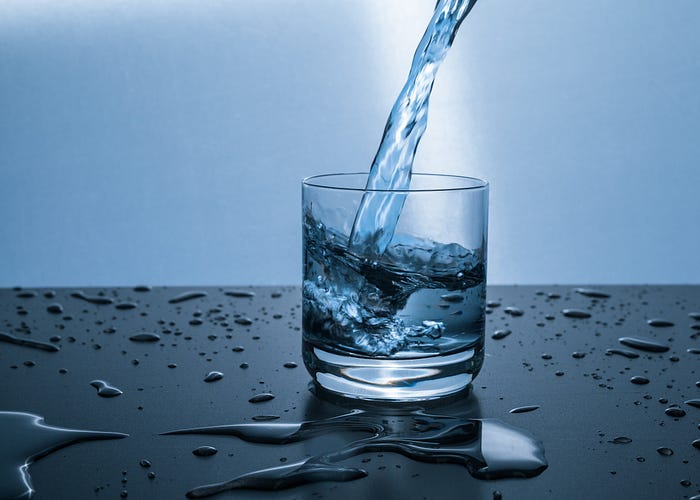
About 20 years ago, I came across an article recommending that adults drink two litres of water a day. In the United States, where litres aren’t commonly used, this became known as the “8×8 rule” — eight 8-ounce glasses of water daily. Over time, I began seeing more and more articles promoting the same idea: that optimal health requires steadily increasing amounts of water. The highest recommendation I’ve seen is 3.7 litres (about sixteen 8-ounce glasses) for men and 2.7 litres (about eleven and a half glasses) for women.
And keep in mind — those figures are often described as minimums for a sedentary person in a cool environment. The advice typically adds that you should drink even more in hot weather or during physical activity. Recently, I read a piece on Medium titled I Drank 3.78 Liters of Water Daily for 30 Days, in which the author describes the challenge of forcing down a gallon of water every single day for a month.
What exactly is going on here? I drink only three or four glasses of water a day. I’m 65 years old, reasonably active, and in excellent health.
When people read claims that drinking a gallon of water daily is essential for good health, many feel compelled to push themselves to meet that target. But let me tell you — it’s not easy to drink a gallon of water every day. Capitalizing on this trend, companies now sell dozens of “1-Gallon Motivational Water Bottles” with time markings, some priced as high as $180 on Amazon and in sporting goods stores.
I also notice that many people carry water bottles everywhere they go — even if they’re stepping out for just a few minutes. It raises an important question: Do we really need to stress ourselves out about not drinking enough water?

What are the Recommendations for Drinking Water?
There is no uniform recommendation about how much water one should drink — it varies from no recommendation to 1.0 to 3.7 litres/day. According to The National Academies of Sciences, Engineering and Medicine report published in 2004:
“The report set general recommendations for water intake based on detailed national data, which showed that women who appear to be adequately hydrated consume an average of approximately 2.7 liters (91 ounces) of total water — from all beverages and foods — each day, and men average approximately 3.7 liters (125 ounces) daily.”
On the contrary, Centers for disease Control and Prevention (CDC) has no recommendation for drinking water:
“there is no recommendation for how much plain water adults and youth should drink daily.”
According to the British Nutrition Foundation website,
In the UK, guidance is to drink 6–8 glasses of fluid per day (roughly 1.2 litres).
Confusion about Total Water, Plain Drinking Water and Fluids
There is considerable confusion about whether daily hydration recommendations refer to total water intake from all sources or only to plain drinking water.
For example, the National Academies of Sciences, Engineering and Medicine clearly states that its recommendation applies to “total water — from all beverages and foods.” In other words, it includes water obtained from tea, coffee, milk, juice, and even moisture-rich foods such as fruits and vegetables.
Similarly, the British Nutrition Foundation advises consuming “6–8 glasses of fluid per day,” not “6–8 glasses of water per day.” The word fluid is deliberate and broader than plain water.
Yet many people — and even published articles — blur the distinction between total water, fluids, and plain drinking water. Over time, the nuanced guidance gets simplified, and everything is reduced to one message: drink more plain water. That oversimplification is where much of the misunderstanding begins. In fact, The National Academies of Sciences, Engineering and Medicine report clearly states:
“This report refers to total water, which includes the water contained in beverages and the moisture in foods, to avoid confusion with drinking water only.”
How Much Drinking Water Do I Really Need?
Definitely not litres!
The human body is largely made up of water — as much as 78% in babies and about 50% in older adults. Fortunately, our bodies are remarkably well designed to regulate that balance. The brain carefully manages water and mineral levels across organs, and when hydration begins to drop, it triggers thirst. In response, we naturally reach for water or other fluids.
When we’re in a hot environment or engaging in physical activity, we lose more water through sweat, so thirst increases accordingly. For healthy individuals, drinking according to thirst is generally sufficient.
Even if you accept the idea that we need 2–3 litres of total water per day, much of that comes from everyday foods and beverages — tea, coffee, milk, juice, yogurt (curd), fruits, vegetables, and even pasta. Alcoholic beverages such as beer and wine also contain water, though they’re not ideal hydration sources.
Many fruits and vegetables are surprisingly high in water content. Apples, grapes, oranges, carrots, pears, and pineapple contain about 80% water. Even bananas are roughly 70% water.
In my case, I drink three cups of tea daily, eat yogurt, and consume plenty of fruits and salads. That likely provides 1.5 to 2 litres of water. When I add the three or four glasses of plain water I drink each day, my total intake is more than adequate. And if my body needs more, my brain will let me know — through thirst.
There’s no need to count glasses or obsess over bottle markings. In fact, even the National Academies of Sciences, Engineering and Medicine notes that hydration needs vary by individual and that most healthy people meet their requirements simply by drinking when thirsty.
“However, on a daily basis, fluid intake driven by thirst and the habitual consumption of beverages at meals is sufficient for the average person to maintain adequate hydration.”
Is Drinking a Lot of Water Good For Health?
If you drink excessive amounts of water, you will certainly make more frequent trips to the washroom. But does that automatically translate into better overall health? Not necessarily.
Some people believe that drinking large quantities of water significantly improves bladder function in men. However, for most healthy individuals, the body already regulates hydration efficiently. Simply forcing down extra litres of water does not guarantee added health benefits — and in some cases, it may just mean more inconvenience rather than meaningful improvement. However, according to the research paper, “Is it possible to improve elderly male bladder function by having them drink more water? A randomized trial of effects of increased fluid intake/urine output on male lower urinary tract function”:
“Conclusions: It seems possible to improve some aspects of male bladder function by drinking more water. However, the effects are too small to be clinically relevant.”
According to a randomized controlled trial, “The effects of 6 months of increased water intake on blood sodium, glomerular filtration rate, blood pressure, and quality of life in elderly (aged 55–75) men”,
“Blood pressure, sodium level, GFR (Glomerular Filtration Rate), and QOL did not change significantly in either group during the intervention period.”
According to another research paper, “How much water do we really need to drink?”,
“Everywhere around us we see people sipping bottled water. … The recommended total daily fluid intake of 3,000 ml for men and of 2,200 ml for women is more than adequate. Higher fluid intake does not have any convincing health benefits, except perhaps in preventing (recurrent) kidney stones.”
Prior to 1969, athletes were commonly advised not to drink water during exercise. Over time, that guidance gradually shifted — first to encouraging hydration during workouts, and now to recommending that athletes begin hydrating even before they start exercising. Drinking too much water may result in low concentration of sodium in the blood (hyponatremia), which can even be fatal! This has been discussed in the research paper, “Is drinking to thirst optimum?”
“Methods: Literature survey of all studies comparing the effects of drinking to thirst (ad libitum) and drinking to prevent any weight loss during exercise — the ‘zero percent dehydration’ doctrine.
Result: No study found that drinking more than ad libitum during exercise produced any biological advantage, but it could cause exercise-associated hyponatremia.”
While there is no doubt that our bodies need adequate water to function properly, drinking excessive amounts does not automatically translate into better health. In fact, overconsumption of water can, in rare cases, lead to hyponatremia — a condition in which sodium levels in the blood become dangerously diluted.
Final Thoughts
For most healthy people, drinking to thirst is sufficient. Remember, your body receives water not only from plain drinking water but also from tea, coffee, milk, fruits, vegetables, yogurt, and other foods. There is no need to force yourself to consume excessive amounts.
It’s also worth recognizing that some businesses may benefit from promoting ever-higher water targets. Humans have lived for thousands of years without measuring their daily water intake or carrying marked gallon bottles everywhere. Our bodies are well equipped with natural signals — we simply need to listen to them.
What are your thoughts on this post? Share your comments with us.
Stay ahead of the curve. Subscribe here to get notified whenever I publish a new guide or tool.
Share your comment or feedback. We'll get back to you as soon as we can.